
Learning Hub
Glossary
Shear Strength
Shear strength is the maximum amount of force a material or fastener can withstand when two opposing forces try to slide one part of it across another, essentially trying to “cut” or “shear” it. Instead of pulling the fastener apart (tension) or crushing it (compression), shear acts sideways, across the fastener’s cross-section.
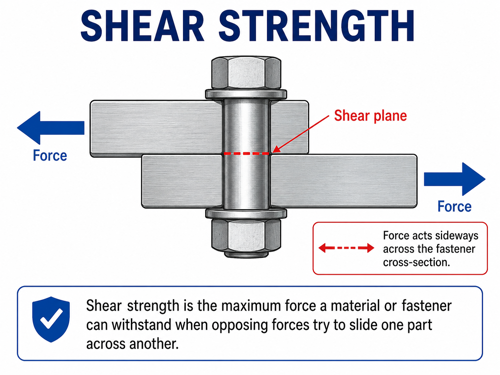
In fasteners, shear strength is a critical measure of how a bolt, pin, rivet, or screw will perform when loads push across it rather than pull on it. A bolt holding two plates together in double-shear, a clevis pin in machinery, a wheel stud supporting a rotating hub, or a rivet in sheet metal all experience shear loads. Typically, shear strength for steel fasteners is roughly 60% of their tensile strength, though the exact value depends on material, grade, heat treatment, and manufacturing method.
Understanding shear strength is essential in industrial design, construction, and fastener selection because a fastener may meet tensile requirements but still fail if exposed to high lateral forces. In applications with vibration, shock loading, joints that shift, rotating equipment, or structural members that bear sideways loads, choosing a fastener with the correct shear capability is just as important as selecting the right tensile strength or hardness.