
Learning Hub
Glossary
Tensile Load
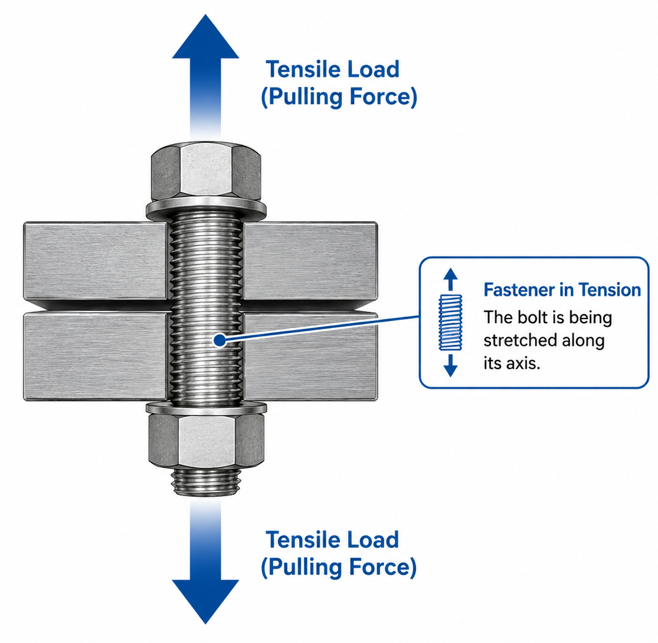
Tensile load is a pulling force applied along the length of a material, fastener, or assembly that tries to stretch it or pull it apart. In fastener terms, tensile load acts in the same general direction as the bolt or screw’s axis, placing the fastener in tension rather than shear, compression, or bending.
For example, when a bolt clamps two plates together, the bolt is stretched slightly as the nut is tightened. That stretch creates tension in the bolt, and the resulting clamping force holds the joint together. If an external force then tries to separate the plates, that force adds tensile load to the fastener. If the tensile load becomes too high, the fastener may permanently stretch, yield, neck down, fracture, or pull the threads out of the mating part.
Tensile load is different from tensile strength. Tensile load is the actual force being applied, usually measured in pounds-force, newtons, kilonewtons, or kips. Tensile strength is the material’s ability to resist that force before yielding or breaking, usually expressed as stress, such as psi, ksi, MPa, or N/mm².
In bolted joints, tensile load is closely related to preload or clamp load. Preload is the intentional tensile load created in a fastener during tightening. A properly tightened bolt behaves a little like a stretched spring: it pulls the joint members together and helps prevent loosening, joint separation, fatigue failure, and leakage in gasketed assemblies.
A simple way to picture it: if you pull on both ends of a bolt, rope, rod, or threaded stud, you are applying tensile load. The part is being asked, “How much pulling force can you take before you stretch too far or break?”