
Learning Hub
Glossary
Nut Factor
Nut factor is an empirical, dimensionless value used to estimate how much tightening torque is needed to produce a desired amount of tension, or preload, in a threaded fastener. It is commonly represented by the letter K and is used in the simplified relationship torque equals nut factor multiplied by nominal fastener diameter multiplied by desired preload, often written as T = K × D × F.
In this relationship, T is the tightening torque, K is the nut factor, D is the nominal fastener diameter, and F is the desired bolt tension or clamp load. For example, when the fastener diameter and target preload are known, engineers can select an appropriate nut factor to estimate the required tightening torque.
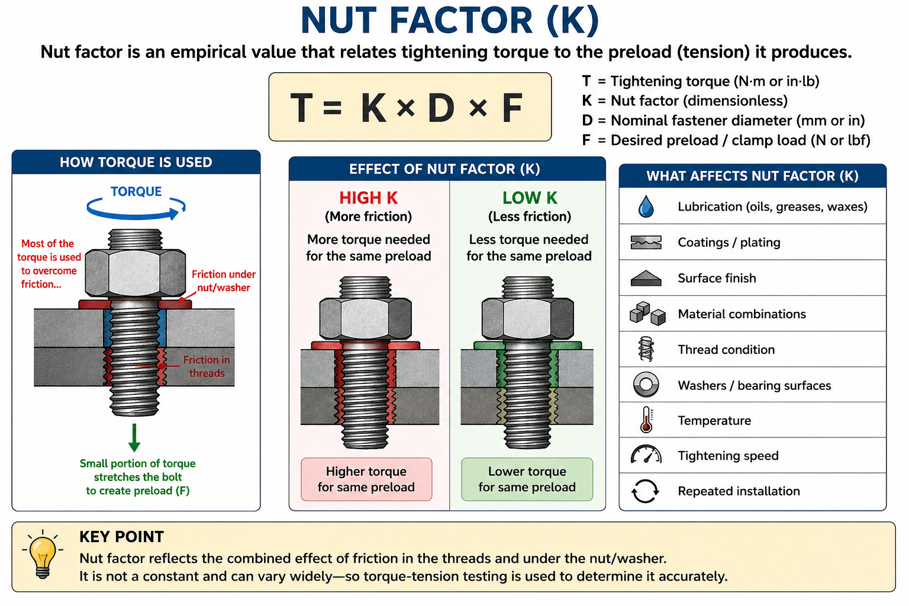
The nut factor accounts primarily for the friction that occurs in the fastening system. Friction develops between the mating threads and beneath the rotating nut, bolt head, or washer. Because most of the applied torque is consumed overcoming this friction, only a relatively small portion of the torque actually stretches the fastener and creates useful clamp force. A higher nut factor generally means more torque is required to reach a given preload, while a lower nut factor means the fastener will produce more preload at the same applied torque.
The value of the nut factor can be affected by lubrication, coatings, plating, waxes, surface finish, material combinations, thread condition, washers, tightening speed, temperature, and repeated installation. A dry, rough fastener system may have a higher nut factor than the same fastener with a controlled lubricant. This means that applying the same torque to the two fasteners could produce very different clamp loads.
Although the term includes the word “nut,” nut factor applies to the complete tightening system rather than to the nut alone. It reflects the combined behavior of the threads, bearing surfaces, lubricant, coating, and installation conditions. It is also not the same as the coefficient of friction. The coefficient of friction describes resistance between specific contacting surfaces, while the nut factor is a broader practical value used to connect tightening torque with the resulting preload.
Nut factor values are often based on testing, published specifications, or prior experience. Because the value can vary significantly between fastener lots and surface conditions, torque-tension testing is commonly used when accurate or consistent clamp load is important. In practical terms, the nut factor answers the question: How efficiently does the applied tightening torque create tension in this particular fastener assembly?