
Learning Hub
Glossary
Coefficient Of Friction
Coefficient of friction is a dimensionless value used to describe how strongly two surfaces resist sliding against one another. It is commonly represented by the Greek letter μ, pronounced “mu.” The coefficient of friction is calculated by dividing the friction force by the normal force pressing the two surfaces together. In other words, μ equals friction force divided by normal force.
A higher coefficient of friction means the surfaces resist movement more strongly, while a lower coefficient means they slide more easily. For example, dry, rough, or damaged surfaces generally produce more friction than smooth or lubricated surfaces. Because the coefficient of friction is a ratio between two forces, it has no unit of measurement.
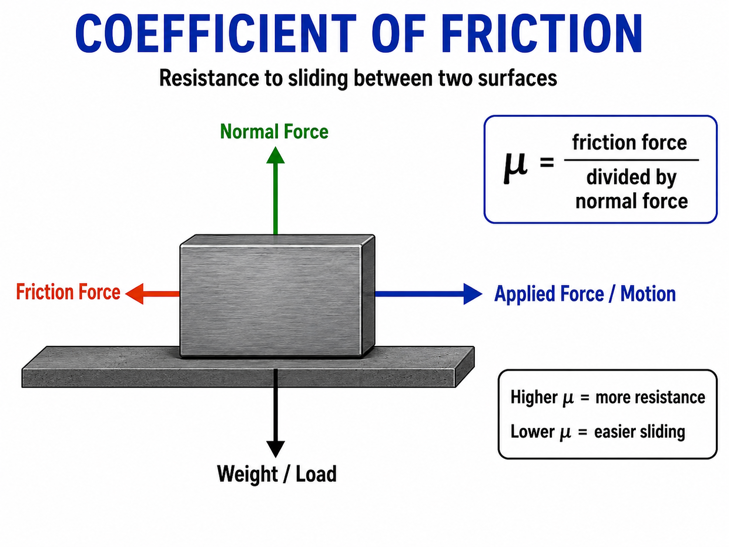
There are two basic types. The static coefficient of friction describes the resistance that must be overcome to begin movement, while the kinetic coefficient of friction describes the resistance after the surfaces are already sliding. Static friction is usually higher because it generally takes more force to start movement than to keep an object moving.
In threaded fastener applications, the coefficient of friction has a major influence on how tightening torque is converted into bolt tension or clamp load. Friction occurs primarily between the mating threads and beneath the rotating bolt head, nut, or washer. Much of the applied torque is consumed overcoming this friction rather than stretching the bolt. As a result, even a relatively small change in friction can produce a significant change in preload.
A fastener with a high coefficient of friction may require more torque to reach the desired clamp load. A fastener with a low coefficient of friction may generate much greater tension at the same torque, potentially causing yielding, thread damage, or fastener failure. Lubricants, waxes, coatings, plating, surface finish, material hardness, contamination, temperature, and repeated installation can all affect the coefficient of friction.
The coefficient of friction should not be treated as a permanent property of a material by itself. It describes the behavior of a particular pair of surfaces under specific conditions. A zinc-plated bolt with a lubricant, for example, may have a very different coefficient of friction from the same bolt installed dry. This is why torque-tension testing is often used to measure friction behavior under conditions that closely match the actual assembly.