
Learning Hub
Glossary
ECHA
ECHA stands for the European Chemicals Agency. It is the EU agency responsible for helping implement and manage major European chemical-safety laws. Its work is focused on protecting human health and the environment through safer chemical use, better chemical information, and risk management. ECHA is a decentralized EU agency based in Helsinki, Finland, and it was established in 2007.
ECHA is especially important because it is the central agency behind REACH, the EU’s main chemical regulation. Under REACH, companies must provide information about certain chemical substances they manufacture or import, and that information is submitted into systems managed by ECHA. The European Commission describes ECHA as the central point in the REACH system because it manages the necessary databases, coordinates detailed evaluation of chemical information, and operates public databases where professionals and consumers can find hazard information.
ECHA also supports other EU chemical laws, including CLP for classification, labelling, and packaging of chemicals; the Biocidal Products Regulation; and the Prior Informed Consent Regulation for certain hazardous chemical exports and imports.
For manufacturers, importers, and distributors, ECHA matters because it is where many EU chemical-compliance obligations connect. Companies may use ECHA resources to check substance registrations, identify Substances of Very High Concern, review restrictions, understand classification requirements, and respond to customer questions about chemicals in products.

Mechanical Galvanizing
Mechanical galvanizing is a zinc coating process used to protect steel parts from corrosion by mechanically bonding zinc particles onto the surface. It is commonly used on small steel components such as fasteners, washers, clips, springs, stampings, and other parts that can be processed in bulk.
Unlike electroplating, mechanical galvanizing does not use electrical current to deposit zinc. Unlike hot-dip galvanizing, it does not require dipping the part into molten zinc. Instead, the parts are placed in a rotating barrel or drum with zinc powder, impact media such as glass beads, water, and chemical promoters. As the barrel turns, the glass beads repeatedly strike the parts and cold-weld or mechanically compact the zinc particles onto the steel surface.
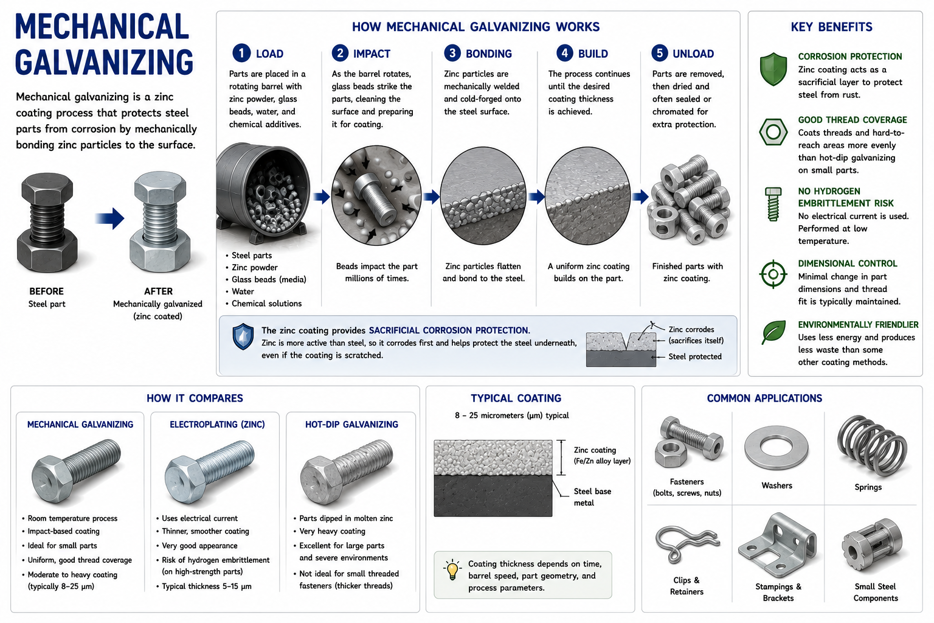
The zinc coating provides sacrificial corrosion protection. Zinc is more active than steel, so when the coated part is exposed to moisture, oxygen, or salts, the zinc corrodes first and helps protect the steel underneath. This means mechanical galvanizing can continue protecting small exposed areas even if the coating is scratched or slightly damaged.
Mechanical galvanizing is especially useful for threaded fasteners because it can provide a protective zinc coating with less risk of hydrogen embrittlement than some electroplating processes. Since no electrical current is used to force the coating onto the part, and the process is typically performed at relatively low temperatures, it is often selected for hardened or high-strength fasteners where embrittlement risk must be carefully managed.
The coating is generally more uniform than hot-dip galvanizing on small threaded parts and usually causes less thread buildup. However, it may not provide the same heavy coating thickness as hot-dip galvanizing in severe outdoor environments. The final performance depends on coating thickness, post-treatment, sealing, part geometry, and service conditions.
Mechanical galvanizing should not be confused with mechanical plating, although the two are closely related. Mechanical plating usually refers to thinner mechanically applied metallic coatings, while mechanical galvanizing usually refers to heavier zinc coatings intended for stronger corrosion protection.
AKA: Peen Plating
Mechanical Properties
Mechanical properties are the characteristics that describe how a material responds to applied forces and loads. In the fastener industry, mechanical properties are used to evaluate a fastener's strength, hardness, ductility, and ability to withstand stress without failure. Common mechanical properties include tensile strength, yield strength, proof load, hardness, and elongation. These properties help engineers and manufacturers determine whether a fastener is suitable for a specific application and performance requirement.