
Learning Hub
Glossary
Coal
Coal is a combustible sedimentary rock formed from ancient plant material that was buried, compressed, and chemically changed over millions of years. As layers of dead vegetation were covered by mud, sand, and other sediments, heat and pressure gradually drove off water and volatile compounds, leaving behind a carbon-rich material that can burn and release energy.
Coal is made mostly of carbon, but it also contains hydrogen, oxygen, nitrogen, sulfur, mineral matter, and moisture. The exact composition depends on the original plant material, how deeply it was buried, how long it was exposed to heat and pressure, and the geologic conditions of the deposit.
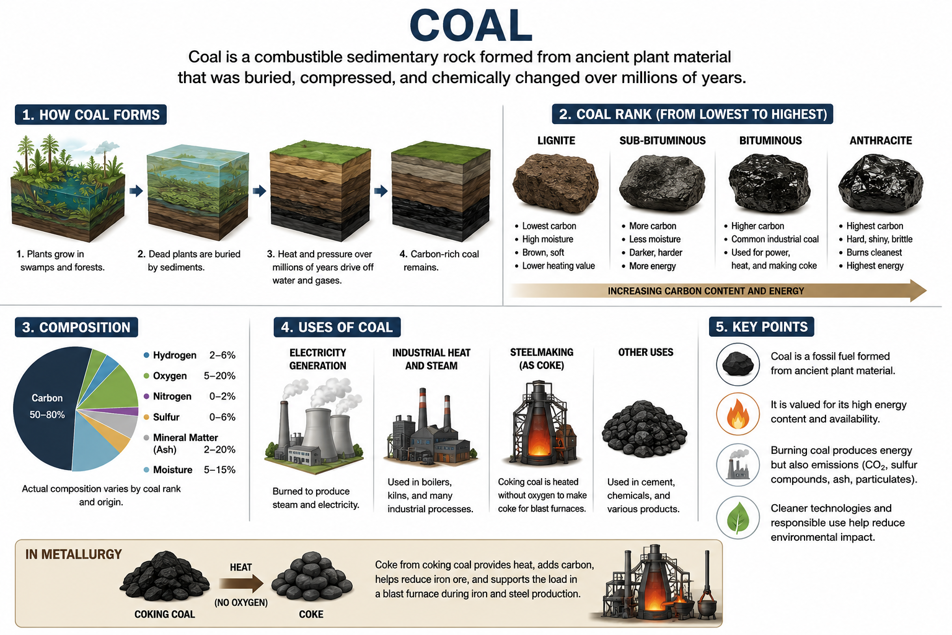
Coal is commonly classified by rank, which describes how much the material has changed from soft plant matter into harder, more carbon-rich fuel. The main ranks are lignite, sub-bituminous coal, bituminous coal, and anthracite. Lignite is lower in carbon and higher in moisture, while anthracite is harder, shinier, and higher in carbon. Bituminous coal is especially important industrially because certain types can be converted into coke for steelmaking.
Coal has historically been used as a fuel for heating, electricity generation, steam production, and industrial processes. When burned, the carbon in coal reacts with oxygen and releases heat, producing carbon dioxide and other combustion products. Because coal can also contain sulfur and mineral impurities, burning it may produce sulfur compounds, ash, particulates, and other emissions that require control.
In metallurgy, coal is important because selected grades of coking coal can be heated in the absence of oxygen to make coke. Coke is stronger, more porous, and more carbon-rich than ordinary coal, making it useful in a blast furnace. There, it provides heat, helps remove oxygen from iron ore, adds carbon to molten iron, and supports the furnace charge.