
Learning Hub
Glossary
Thermocouple
A thermocouple is a rugged, widely used temperature sensor that measures temperature by generating a small voltage when two dissimilar metal wires are joined at a sensing point (the hot junction). That voltage is produced by the Seebeck effect: when there’s a temperature difference between the hot junction and the other end of the circuit (the reference/cold junction), the thermocouple produces a predictable millivolt signal that a meter or controller converts into temperature.
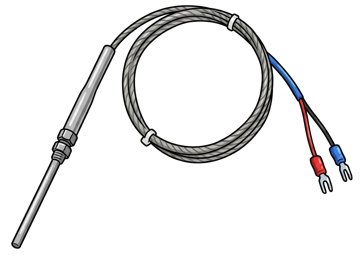
A thermocouple doesn’t measure “absolute” temperature by itself—it measures a temperature difference, which is why instruments use cold junction compensation (CJC) to account for the temperature at the connection point. In practical terms: the device measures the thermocouple voltage, measures the reference junction temperature, then calculates the actual hot junction temperature from standard thermocouple tables.
Thermocouples are popular in industrial and chemical environments because they’re simple, inexpensive, fast-responding, and tolerant of harsh conditions, including wide temperature ranges, vibration, and dirty environments. Different thermocouple “types” (like K, J, T, E, N, R, S, B) are standardized combinations of metals chosen for different ranges and corrosion resistance—Type K is the common general-purpose workhorse, while noble-metal types (R/S/B) are used for very high temperatures. Accuracy depends on the type, wire grade, calibration, installation (good thermal contact), and environment (some atmospheres can drift the metallurgy over time).