
Learning Hub
Glossary
Seebeck Effect
The Seebeck effect is the phenomenon where a voltage is generated when there’s a temperature difference along a conductor—or more commonly, across a circuit made from two dissimilar conductors. In plain shop language: heat on one end and cooler on the other can create a measurable electrical “push.”
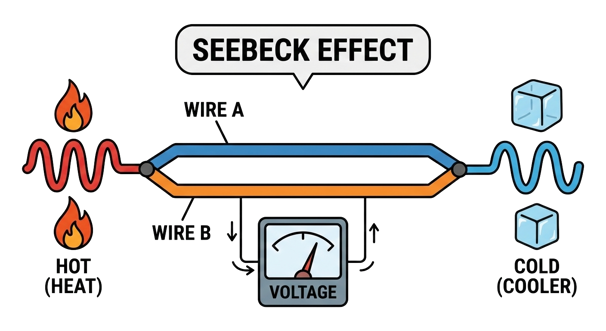
In a thermocouple circuit, you join two different metals at the hot junction. If that junction is at a different temperature than the other end of the circuit (the reference/cold junction), the materials produce a small thermoelectric voltage (usually in millivolts) that is roughly proportional to the temperature difference. The exact voltage-vs-temperature relationship depends on the specific metal pair (that’s why Type K, J, T, etc. each have their own tables/curves).
Why it matters industrially: it’s the physics that lets thermocouples work in furnaces, reactors, heat exchangers, piping, and anywhere you need a sensor that’s tough, cheap, and happy at high temperatures. The key gotcha is that the Seebeck effect gives you a voltage tied to a temperature difference, so instrumentation uses cold junction compensation to convert that into an actual temperature reading.