
Learning Hub
Glossary
Powder Metallurgy
Powder metallurgy (PM) is a manufacturing method where you make metal parts from metal powders instead of melting a bulk ingot and machining it down. In its classic form, PM means you blend a controlled powder mix, compact it in a die into a “green” (unsintered) shape, then sinter it—heating it to a temperature below the main metal’s melting point so the powder particles bond together into a solid part.
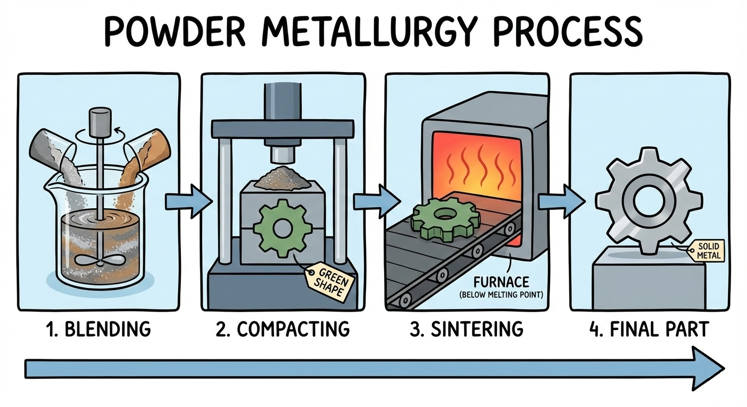
The most common production route is called press-and-sinter. The powder is pressed (often at room temperature) in a rigid die, then sintered in a controlled atmosphere furnace to develop strength and final properties; secondary steps like sizing/coining, heat treatment, machining, or impregnation may follow if tighter tolerances or special performance is required. The Metal Powder Industries Federation describes press-and-sinter as the basic conventional PM process using pressure and heat to form precision metal parts.
PM is widely used because it can produce near-net-shape parts with excellent repeatability at high volume, often with less material waste than machining. It also enables properties that are hard to get other ways—like controlled porosity (useful for self-lubricating bearings or filtration) and certain hard materials such as cemented carbides.
The tradeoffs are real: conventional press-and-sinter parts can retain some residual porosity, which can reduce ductility and fatigue strength compared to fully wrought material unless you use densification methods (e.g., hot isostatic pressing, forging after sintering, or other advanced PM routes). That’s why PM shines in applications where its shape capability + cost + repeatability beat out machining, and why critical structural parts may require higher-density PM processes.