Learning Hub
Glossary
Grub Screw
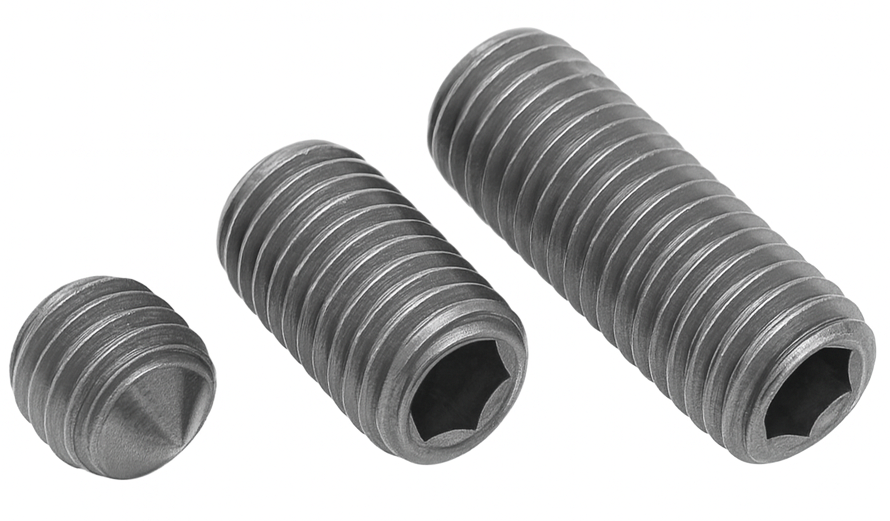
A grub screw, also known as a set screw, is a type of fastener specifically designed to secure one component against another without the need for a nut. Unlike conventional screws, a grub screw has no head—its entire body is threaded, and it is tightened or loosened using a recessed drive such as a hex socket (Allen), slotted, or Torx. This makes it ideal for applications where a flush or hidden fastening solution is required.
In terms of design and construction, grub screws are generally short, fully threaded cylindrical fasteners. Since they lack a head, they sit flush with or below the material’s surface when installed, creating a clean finish. The screw’s working end may be shaped in different styles—flat, cone, cup, dog, or oval—to suit how it grips the mating part. Materials such as alloy steel, stainless steel, and brass are commonly used, with heat treatments or coatings often added to enhance strength and corrosion resistance.
The main function of a grub screw is to lock two parts together by applying pressure at a single point. They are most frequently used to secure rotating components, such as gears, pulleys, or collars, onto shafts. By tightening the screw so that its tip presses directly against the shaft surface or into a prepared recess, the grub screw prevents movement, slippage, and misalignment, even under vibration or torque.
Grub screws have wide applications across industries. In machinery, they secure pulleys, gears, and collars. In electronics and instruments, they lock knobs or dials in place on rotary shafts. The automotive and aerospace industries use them in linkages, couplings, and compact rotating mechanisms where space is restricted. They also find use in furniture and fixtures, holding parts together discreetly without visible fastener heads.
The advantages of grub screws include their compact, flush fit with no protruding head, their ability to provide strong localized locking force, and the availability of various tip styles for different uses. They are also inexpensive and require only basic tools for installation. However, they come with limitations. Grub screws can damage shaft surfaces if not used with a flat or recessed spot, and they generally provide less holding strength than larger headed fasteners. They can also be difficult to remove if overtightened or if the drive recess becomes stripped. Additionally, effective use requires precise alignment and sufficient thread engagement.
AKA: Set Screw