
Learning Hub
Glossary
Extrados
The extrados of a tube or pipe is the outside surface of a bend, located on the outer radius of the curved section. It is the side of the tube that travels the longest arc length through the bend, which is why it experiences the greatest stretching (tensile strain) as the tube is formed.
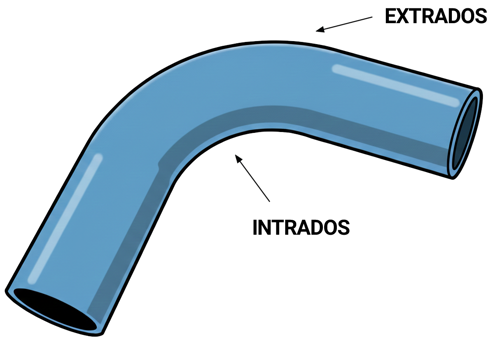
Because the extrados is in tension during bending, it is the area most prone to characteristic bend-related changes and defects. The wall at the extrados typically becomes thinner as the material elongates, and it can show higher residual tensile stress, surface tearing, or microcracking if the bend radius is tight, the material is low-ductility, or the process control is poor. In processes like induction bending, where the bend is created in a localized hot zone, extrados behavior is closely monitored because heat input, feed force, and cooling rate can influence thinning, ovality, and local hardness/microstructure.
Extrados is commonly referenced in bend specifications and inspections alongside the intrados (the inside surface of the bend), because many acceptance criteria are based on measured extrados thinning, ovality/out-of-round, and the final bend geometry. In short: if you’re evaluating a bent tube for dimensional integrity and durability, the extrados is the primary “watch area” for tensile-stretch effects.