
Learning Hub
Glossary
Induction Bending
Induction bending is a pipe and tube forming process that uses a localized electromagnetic induction coil to rapidly heat a narrow band of material (the “hot zone”) to a controlled temperature while the pipe is mechanically pushed or pulled through a bend radius. As the pipe advances, the heated section becomes plastic and bends, and the pipe is then immediately cooled (often with air or water spray) behind the coil to “freeze” the shape as the hot zone moves along the bend.
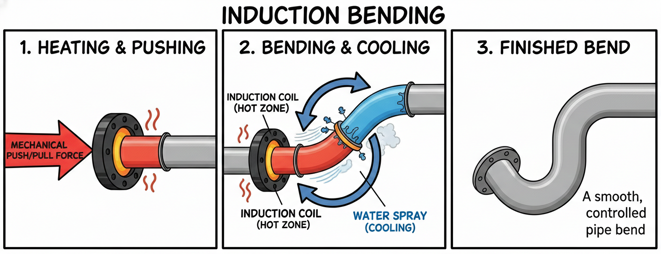
Induction bending is widely used to make large-radius bends in carbon steel, alloy steel, and stainless steel piping, as well as structural tube and hollow sections, especially when you need smooth flow paths, fewer weld joints, and consistent geometry. Because only a small region is heated at a time, the process can produce long, controlled bends efficiently, but it must be managed for typical bend effects such as wall thinning on the extrados (outside of the bend), wall thickening on the intrados (inside of the bend), and possible ovality and springback. For higher-alloy materials or critical service, requirements may include controls for heat input, quench method, hardness/microstructure, and post-bend heat treatment, along with dimensional inspection and, when applicable, NDE, to ensure the bend meets code and performance needs.