
Learning Hub
Glossary
Ovality
Ovality is the amount a feature that should be perfectly round—such as a shank diameter, hole, tube, bushing, or thread pitch diameter—deviates into an oval (out-of-round) shape. Instead of having one true diameter everywhere, the part has a largest measured diameter and a smallest measured diameter depending on the measurement direction.
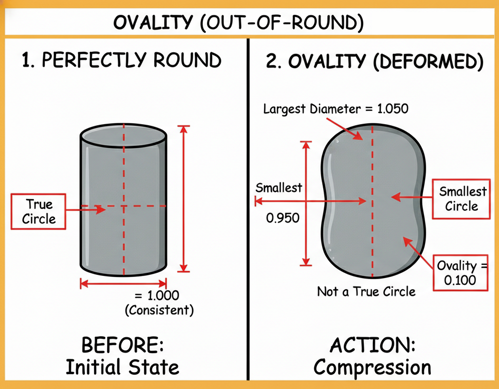
Ovality is typically quantified as the difference between those values, for example ovality = Dmax − Dmin (sometimes reported as a percentage of the nominal diameter). In fasteners and precision hardware, ovality matters because it can affect fit and assembly (clearance holes, bushings, sleeves), thread engagement (especially in tight tolerance threads), bearing/contact patterns, and the repeatability of torque-to-tension behavior when components don’t contact uniformly. It can be introduced by manufacturing processes (rolling, drawing, bending, plating buildup, heat treatment distortion) or by service loads that plastically deform a part in one direction.