
Learning Hub
Glossary
Charpy Impact Test
The Charpy impact test (often the Charpy V-notch test) is a standardized impact test used to measure how much energy a material absorbs when it fractures under a high strain-rate blow. The reported value—absorbed impact energy—is used as a practical indicator of a material’s notch toughness (how resistant it is to cracking when a notch/flaw is present).
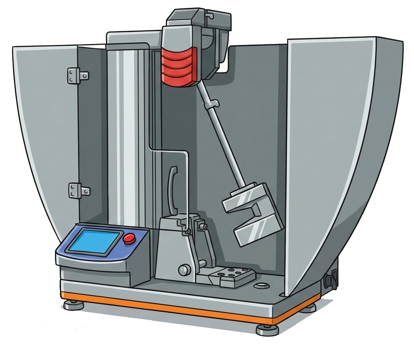
The setup is straightforward: a pendulum hammer of known mass and drop height strikes a notched specimen supported like a small beam. The machine measures the difference in the pendulum’s height (energy) before and after the strike, which corresponds to the energy absorbed in breaking the specimen. In common Charpy practice, the notch faces away from the striker so the impact loads the notch in bending and encourages a crack to initiate at the notch root.
Specimen geometry is tightly controlled because the notch shape strongly affects the result. A widely used standard specimen is 55 mm long with a 10 mm × 10 mm cross-section, with a central V-notch (commonly 45°, often 2 mm deep with a 0.25 mm notch root radius, depending on the standard and setup). Testing is commonly specified under ASTM E23 or ISO 148-1, which define the method, equipment checks, and permitted specimen/notch variants (V-notch and U-notch).
Where Charpy really earns its keep is in steels and other alloys that show a ductile-to-brittle transition with temperature. By running Charpy at multiple temperatures, you can build a curve of absorbed energy vs. temperature and identify transition behavior (and sometimes specify minimum absorbed energy at a given temperature for service). It’s widely used for materials qualification and quality control because it’s comparatively fast and repeatable when the specimen prep and temperature control are done correctly.
The main limitation is that Charpy is not a direct fracture-toughness (K_IC) test—it’s an impact energy test on a notched bar—so results are best used for comparisons, screening, and specification compliance rather than as a fundamental design property. Because it’s sensitive to notch geometry, specimen size, test temperature, and strain rate, those details must match the relevant standard and the service question you’re trying to answer.
The Charpy impact test is named for Georges Augustin Albert Charpy, a French engineer who standardized the notched-bar pendulum impact method in 1901—that standardization work is why the test carries his name.
It’s worth noting the pendulum impact-testing idea predates Charpy: S. B. Russell introduced an earlier pendulum fracture test in the 1890s, and Charpy’s contribution was to refine and standardize it into the form that became widely adopted.
AKA: Charpy V-Notch Test