
Learning Hub
Glossary
Annealing
Annealing is a heat treatment process used to soften metal, relieve internal stresses, improve ductility, and refine grain structure—essentially restoring a metal’s workability and toughness after it has been hardened or deformed through processes like forging, machining, or cold working.
The annealing process involves three main stages: recovery, recrystallization, and grain growth. The metal (often steel, copper, aluminum, or brass) is first heated to a specific temperature—high enough to allow atomic diffusion and structural changes, but below its melting point. For steel, this is typically between 550°C and 750°C (1020–1380°F), depending on composition. The metal is then held (soaked) at that temperature long enough for its internal structure to homogenize, allowing new strain-free grains to form. Finally, the material is slowly cooled, usually in the furnace, to prevent new stresses or hard microstructures from developing.
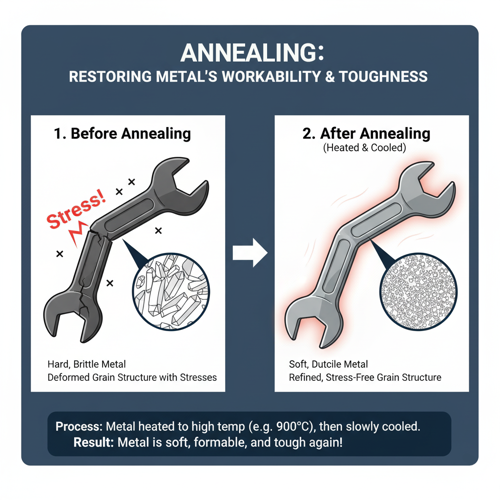
In carbon and alloy steels, the goal of annealing is to transform the microstructure (often distorted ferrite and pearlite from prior processing) into a softer, more uniform arrangement. This process eliminates dislocations and internal stresses created during cold working or welding, restoring ductility and machinability. In non-ferrous metals like copper or aluminum, annealing serves a similar purpose—removing work hardening effects and returning the metal to a more pliable state for further forming or shaping.
There are several types of annealing, each tailored to specific materials and goals:
- Full annealing: Heats steel above its critical temperature (austenitizing range) and cools it slowly to produce coarse pearlite—a very soft structure ideal for machining.
- Process annealing: Uses lower temperatures to relieve stress and restore ductility without changing the metal’s core structure—often used between cold working stages.
- Spheroidizing anneal: Applied to high-carbon steels to form rounded carbides, improving machinability before hardening.
- Stress-relief annealing: Removes residual stresses after welding, casting, or machining without significantly altering strength or hardness.
The cooling rate is critical: slow cooling in the furnace allows equilibrium microstructures to form, while rapid cooling may produce harder or more brittle phases (as in quenching).
Spheroidized Annealing
Spheroidized annealing, often called spheroidizing, is a heat treatment used mainly on high-carbon steels and alloy steels to change the shape of hard iron-carbide particles from thin plates or networks into small, rounded, sphere-like particles. The goal is to make the steel softer, more ductile, easier to machine, and easier to cold form.
In steel, carbon often exists in a hard compound called cementite, or iron carbide, written as Fe₃C. Depending on the steel’s prior processing, this carbide may be arranged in lamellar pearlite, which looks like alternating layers of ferrite and cementite, or in a more continuous carbide network. Those shapes can make the steel harder and less workable. During spheroidized annealing, the steel is heated and held in a temperature range that allows those carbide structures to break up and round off into tiny globules distributed through a softer ferrite matrix.
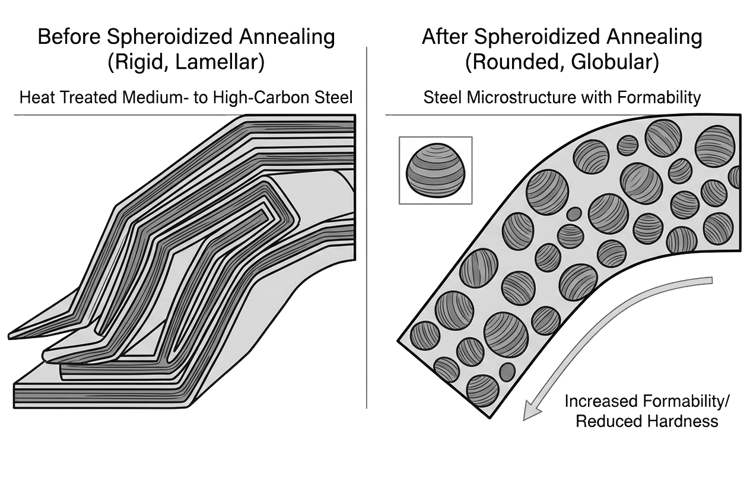
The word spheroidized refers to this rounded carbide shape. Instead of long, plate-like cementite particles acting like internal cutting blades or barriers to deformation, the carbides become more ball-like. Rounded particles create less resistance to plastic flow, so the steel becomes easier to bend, draw, head, thread, machine, or further process.
Spheroidized annealing is especially important for high-carbon steels, bearing steels, tool steels, and certain alloy fastener steels because these materials can be too hard or brittle to form efficiently in their as-rolled or normalized condition. By spheroidizing the carbide structure first, manufacturers can improve cold workability before operations such as cold heading, cold extrusion, thread rolling, stamping, or machining.
In fastener manufacturing, spheroidized annealing is commonly used to prepare wire or rod before making parts that require significant deformation. For example, if a steel wire must be cold headed into a bolt, screw, rivet, pin, or specialty formed part, the material needs enough ductility to flow into shape without cracking. A spheroidized microstructure helps the material survive that forming process while maintaining good dimensional control and reducing tool wear.
The process usually involves heating the steel to just below, at, or cycling around the lower critical temperature, depending on the steel grade and desired structure. The material is then held for a long enough time to allow carbide particles to transform into a rounded morphology, followed by controlled cooling. Exact temperature and time depend on carbon content, alloy content, starting microstructure, section size, and final property requirements.
Spheroidized annealing is different from a general soft anneal because it is specifically aimed at changing the shape and distribution of carbides, not merely reducing hardness. It is also different from hardening heat treatment, which aims to create martensite for high strength and hardness. Spheroidizing is usually a preparatory process: it makes the steel easier to manufacture, and the part may later be quenched, tempered, carburized, plated, coated, or otherwise finished.
AKA: Spheroidizing