
Learning Hub
Glossary
Work Hardening
Work hardening (also called strain hardening) is the strengthening of a metal that occurs when it is plastically deformed, typically by cold-working operations such as cold heading, thread rolling, drawing, bending, stamping, or swaging. As the metal is forced to deform beyond its elastic limit, the density of dislocations in its crystal structure increases and they begin to tangle and obstruct each other, making further plastic deformation more difficult. The practical result is that the material becomes harder and stronger, while generally becoming less ductile.
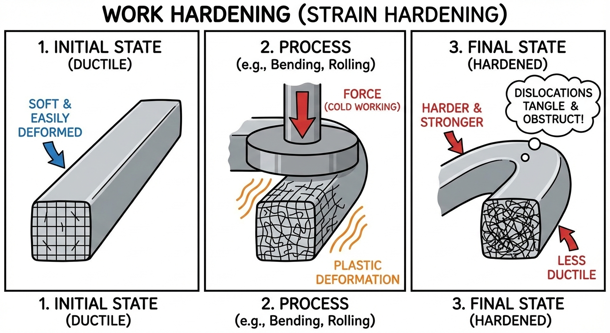
Work hardening is a major factor in fastener manufacturing and performance. Cold-formed fasteners often gain strength from the forming itself, and thread rolling in particular can produce a stronger thread form than cut threads because it both work hardens the surface and preserves favorable grain flow. The tradeoff is reduced formability as work hardening accumulates; if too much cold work is introduced, parts can crack during forming or in service, so manufacturers may use intermediate annealing to restore ductility for additional forming steps. Work hardening can also affect installation and service behavior by increasing the likelihood of galling (especially in stainless steels) and by changing how the material responds under cyclic loading.
AKA: Strain Hardening