
Learning Hub
Glossary
Double Shear
Double shear is a loading condition that occurs when a fastener such as a bolt, pin, or rivet is subjected to shear forces acting in two parallel planes. This means the load is distributed across two cross-sectional areas instead of one, allowing the fastener to resist higher loads than it would in single shear. Essentially, the fastener experiences two simultaneous shearing actions, which makes the connection stronger and more efficient.
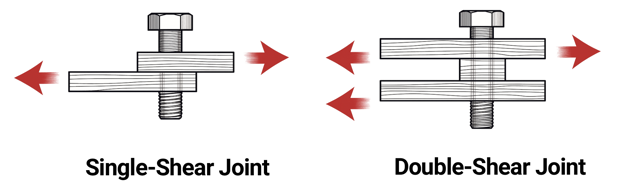
In a single-shear joint, the bolt or pin is only sheared in one location, with the entire load acting on a single cross-section. In a double-shear joint, however, the load passes through two connected members, so the fastener is sheared in two places. Because the load is divided between two shear planes, each carries only half the total force, effectively doubling the joint’s shear capacity when the load is evenly distributed.
A simple example can be seen in bolted plate assemblies. If two plates are joined by a single bolt, that bolt is in single shear. If a third plate is added between them and the bolt passes through all three, the bolt is in double shear. This configuration provides greater strength and stability because it reduces the stress on each shear plane. In practical terms, double shear allows a joint to support more load without increasing the size of the fastener, making it a preferred design in many structural and mechanical applications.