
Learning Hub
Glossary
Press Brake Forming
Press brake forming is a metal forming process that bends sheet metal, plate, or strip stock by pressing it between a punch and a die on a machine called a press brake. The punch pushes the material downward into the die opening, forcing the metal to bend to a controlled angle and radius. It is commonly used to make brackets, channels, angles, enclosures, covers, clips, gussets, panels, and many other formed metal components.
A press brake does not cut the part like a shear or punch press. Its main job is to bend material. The flat workpiece is positioned on the die, the ram drives the punch into the material, and the metal plastically deforms along the bend line. The final shape depends on the punch shape, die opening, material thickness, material strength, bend radius, bend allowance, and how far the punch travels into the die.
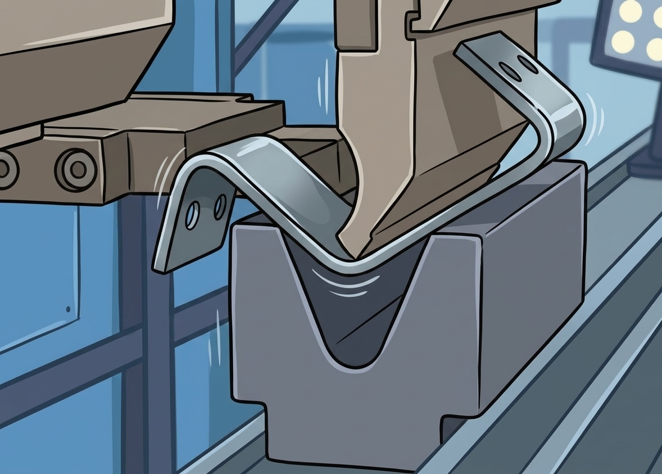
There are several common press brake bending methods. Air bending is the most common method, where the material contacts the punch and the two upper edges of the die opening, but does not fully bottom out in the die. Bottom bending forces the material deeper into the die to produce a more defined angle. Coining uses much higher pressure to press the material tightly into the die shape, creating a more precise bend with less springback, but it requires more tonnage and can mark or thin the material.
In fastener and industrial manufacturing, press brake forming is often used for parts that need controlled bends rather than complex stamped geometry. Examples include formed mounting brackets, support angles, equipment guards, reinforcement plates, custom clips, bent tabs, channels, and per-print fabricated components. It is especially useful for lower- to medium-volume parts, prototypes, custom sizes, and heavy-gauge materials where a dedicated stamping die may not be practical.
Important press brake forming considerations include bend radius, springback, grain direction, material thickness, inside bend angle, die width, and tonnage. If the bend radius is too tight for the material, the outside of the bend can crack. If springback is not accounted for, the part may open up after bending and miss the required angle. If the die opening or tooling is not matched to the material, the part may be distorted, over-marked, or dimensionally inaccurate.