Learning Hub
Glossary
Hafnium (Hf)
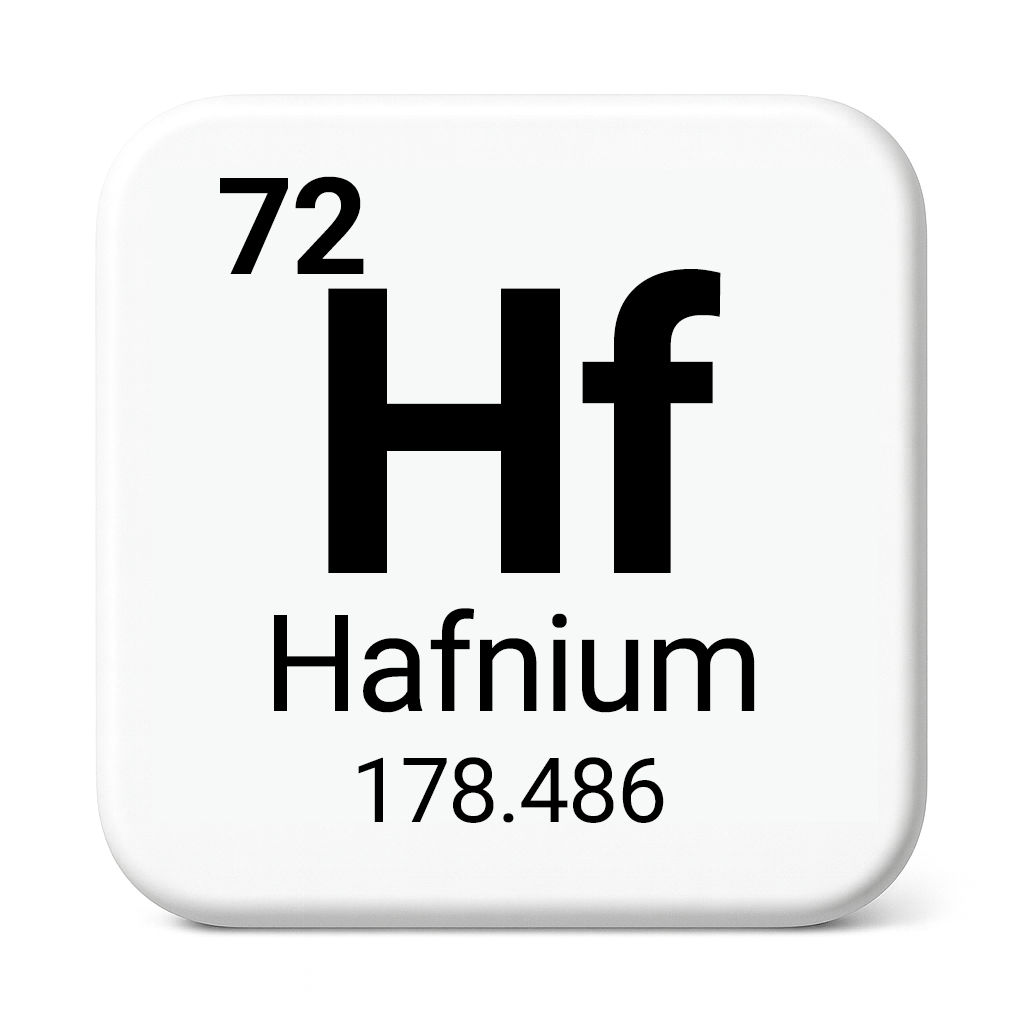
Hafnium is a dense, silvery-gray metallic chemical element with the symbol Hf and atomic number 72. It belongs to the transition metals and is closely related to zirconium. In fact, hafnium and zirconium occur together naturally and have very similar chemical behavior, which makes them difficult to separate during refining.
Hafnium is valued mainly for its high melting point, corrosion resistance, and unusual nuclear properties. It melts at about 2,233°C, or 4,051°F, which places it among the refractory metals, meaning it can tolerate very high temperatures before melting. It also forms a stable oxide layer on its surface, helping it resist corrosion in many environments.
One of hafnium’s most important uses is in the nuclear industry. Hafnium is excellent at absorbing neutrons, so it is used in control rods for nuclear reactors. Control rods help regulate the nuclear fission reaction by absorbing excess neutrons. This is one major difference between hafnium and zirconium: zirconium is useful in nuclear reactors because it does not absorb many neutrons, while hafnium is useful specifically because it does.
Hafnium is also used in high-temperature alloys, superalloys, plasma cutting electrodes, vacuum tubes, microelectronics, and specialized ceramics. In aerospace and advanced materials, small additions of hafnium can improve high-temperature strength, oxidation resistance, and stability. Hafnium carbide, a compound of hafnium and carbon, is known for its extremely high melting point and is studied for very demanding heat-resistant applications.
In modern electronics, hafnium compounds are important because hafnium oxide can act as a high-performance insulating material in semiconductor devices. It has been used in advanced computer chips as a high-k dielectric, helping reduce electrical leakage while allowing continued miniaturization of electronic components.
Hafnium is not commonly encountered as a bulk structural metal in ordinary fasteners because it is expensive, difficult to produce, and reserved for specialized applications. However, it may appear in advanced alloys, high-temperature materials, nuclear components, and research alloys such as refractory high-entropy alloys.