Learning Hub
Glossary
Prevailing Torque
Prevailing torque is the measurable turning resistance created by a locking feature in a threaded fastener assembly—the torque required to keep a nut advancing on a bolt (or a screw advancing in a tapped hole) when the bearing surfaces are not yet in contact and no meaningful clamp load is being developed. It exists because the threads are intentionally made to interfere or increase friction, so the assembly “wants” to resist rotation even before the joint is tightened.
Prevailing torque is produced by locking designs such as nylon-insert locknuts, all-metal locknuts with a distorted/elliptical top or other deformed thread section, thread-forming or thread-deforming features, and pre-applied locking patches (nylon/chemical) on bolts or screws. Because it is fundamentally a friction/interference effect, prevailing torque is separate from the torque required to generate preload in the joint. During tightening, the torque you apply is essentially the sum of (1) the torque needed to overcome this locking resistance and (2) the torque needed to overcome underhead/bearing friction and thread friction while stretching the fastener to create clamp load.
Prevailing torque is commonly verified with a run-on/run-off test: the nut is driven onto a bolt (or the screw into a test nut) and torque is recorded while the assembly is free-running with no bearing contact, ensuring the measurement reflects only the locking feature rather than the friction under the nut face or screw head. Standards typically require prevailing torque to fall within a specified range so the fastener provides reliable resistance to loosening, but not so high that it causes galling, thread damage, or impractical installation. Prevailing torque can change with reuse, temperature, lubrication/coatings, plating thickness, and thread condition; nylon inserts and patches may soften at elevated temperatures, while all-metal prevailing-torque nuts may maintain locking performance better in heat but can be more sensitive to galling on stainless or poorly lubricated assemblies.
Prevailing Torque Nut
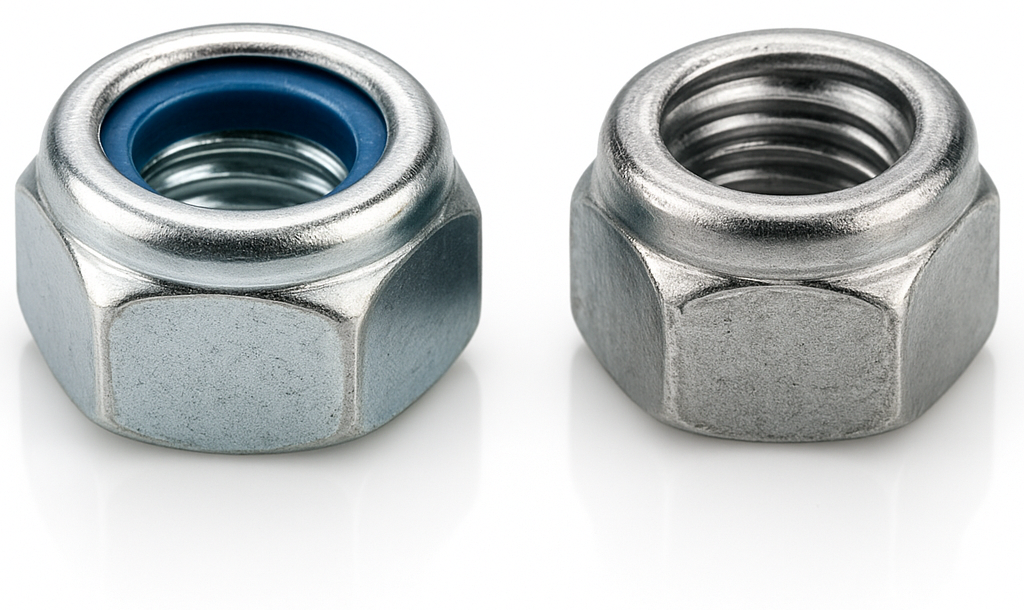
A prevailing torque nut is a locknut with a built-in feature that creates friction on the threads, producing a constant “drag” (the prevailing torque) as it turns. That friction resists loosening from vibration or shock, even when clamp load is low, making the joint more reliable than with a standard nut alone.
There are two main styles: nylon-insert (Nylock), which uses a polymer ring to grip the bolt and is best for general use but limited to about 120 °C/250 °F and a few reuses; and all-metal (distorted-thread/top-lock), which relies on deformed metal threads to pinch the bolt, tolerating higher temperatures and harsher service with limited reusability (the locking torque drops with cycles). Installation torque specs typically account for the added drag, and performance can vary with plating, lubrication, temperature, and reuse. These nuts are common in automotive, machinery, and structural applications where vibration resistance is critical.