
Learning Hub
Glossary
Tensile Ductility Test
A Tensile Ductility Test is a standardized method used to measure how well a material can stretch, elongate, and undergo plastic deformation under a pulling force before it breaks. It provides key information about the ductility, toughness, and overall performance of a material when subjected to tension.
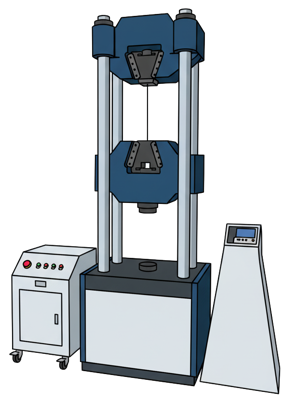
During the test, a specimen such as a machined metal rod, fastener, or another standardized piece is placed in a tensile testing machine. The machine gradually applies a pulling force along the specimen’s axis until the material deforms and eventually fractures. Throughout the test, important data is recorded, including the elongation of the specimen, which shows how much it lengthens as a percentage of its original length, the reduction of area at the fracture point caused by necking, and the full stress-strain behavior, which illustrates the relationship between applied stress and strain from the yield strength through the ultimate tensile strength and finally to fracture.
The purpose of the Tensile Ductility Test is to evaluate how a material responds when exposed to tensile loads. Materials with high tensile ductility, such as mild steel or aluminum, are able to stretch significantly before breaking, while more brittle materials like cast iron or hardened steel fracture with very little elongation.
This type of test is widely used in fastener manufacturing, structural engineering, and materials science. For fasteners in particular, it ensures that bolts, screws, and other components have the toughness required to deform safely without failing suddenly under load, thereby verifying their reliability in real-world applications.
Tensile Load
Tensile load is a pulling force applied along the length of a material, fastener, or assembly that tries to stretch it or pull it apart. In fastener terms, tensile load acts in the same general direction as the bolt or screw’s axis, placing the fastener in tension rather than shear, compression, or bending.
For example, when a bolt clamps two plates together, the bolt is stretched slightly as the nut is tightened. That stretch creates tension in the bolt, and the resulting clamping force holds the joint together. If an external force then tries to separate the plates, that force adds tensile load to the fastener. If the tensile load becomes too high, the fastener may permanently stretch, yield, neck down, fracture, or pull the threads out of the mating part.
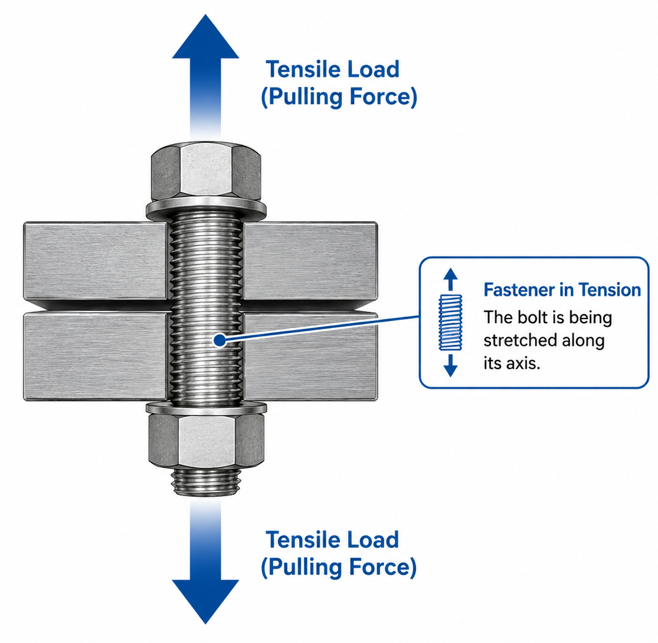
Tensile load is different from tensile strength. Tensile load is the actual force being applied, usually measured in pounds-force, newtons, kilonewtons, or kips. Tensile strength is the material’s ability to resist that force before yielding or breaking, usually expressed as stress, such as psi, ksi, MPa, or N/mm².
In bolted joints, tensile load is closely related to preload or clamp load. Preload is the intentional tensile load created in a fastener during tightening. A properly tightened bolt behaves a little like a stretched spring: it pulls the joint members together and helps prevent loosening, joint separation, fatigue failure, and leakage in gasketed assemblies.
A simple way to picture it: if you pull on both ends of a bolt, rope, rod, or threaded stud, you are applying tensile load. The part is being asked, “How much pulling force can you take before you stretch too far or break?”
Tensile Strength
Tensile strength is the maximum amount of tensile (pulling) stress that a material can withstand before it breaks or fractures. It represents the point on a stress–strain curve where the material reaches its ultimate ability to resist stretching under load. Beyond this limit, the material begins to neck, deform irreversibly, and eventually fail.
In fasteners such as bolts, screws, and rods, tensile strength is one of the most critical mechanical properties. It defines how much tension the fastener can endure before breaking and is usually expressed in megapascals (MPa) or pounds per square inch (psi). For example, a steel bolt with a tensile strength of 800 MPa can withstand a maximum stress of 800 million newtons per square meter before fracturing.
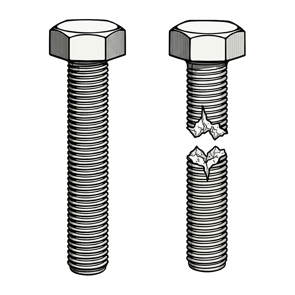
The tensile strength of a fastener is determined through testing, where a sample is gradually pulled apart in a tensile testing machine until it fails. During this process, the material first deforms elastically (it stretches but returns to its original shape), then plastically (it stretches permanently), and finally fractures when the tensile strength is exceeded.
Tensile strength is often used alongside yield strength and proof load to describe a material’s behavior under stress. While proof load represents the maximum stress a fastener can handle without permanent deformation, tensile strength marks the absolute breaking point. For high-strength fasteners—such as those made to grades 8.8, 10.9, or 12.9—the tensile strength can range from 800 MPa to 1,200 MPa or higher, depending on the material and heat treatment.
In summary, tensile strength is a measure of how much pulling force a material can sustain before failure. It is a fundamental indicator of mechanical performance, reliability, and safety in fasteners and structural components, ensuring that parts can resist breaking under load in service conditions.
Wedge Tensile Testing
Wedge tensile testing is a fastener test used to evaluate the tensile strength and head-to-shank integrity of a bolt or screw while it is being pulled at a slight angle. Instead of pulling the fastener perfectly straight, the test uses a wedge-shaped washer or fixture under the head so the fastener is forced to carry tensile load while also experiencing bending stress near the head.
The purpose is to prove that the fastener can withstand a specified tensile load without failing prematurely at a weak transition area, especially where the head joins the shank. That area is important because it often contains geometry changes, fillets, forging flow lines, and possible stress concentrations. A bolt might pass a straight tensile test but still reveal weakness when loaded through a wedge because the angled setup places extra demand on the head-to-body junction.
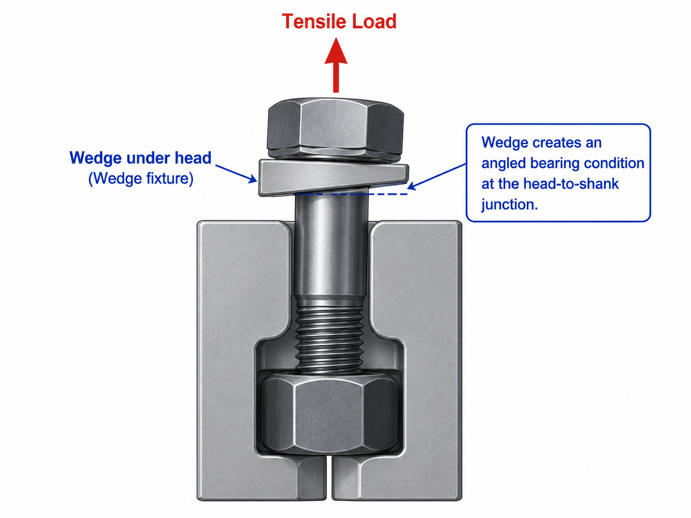
In a typical wedge tensile test, the fastener is installed through a hardened wedge fixture and threaded into a test nut or gripping fixture. A tensile testing machine then pulls the fastener along its axis until it reaches the required proof or tensile load, or until it fractures. The wedge under the head creates a controlled angular bearing condition, making the test more severe than a simple straight pull.
For externally threaded fasteners, wedge tensile testing is commonly used to confirm that the bolt or screw meets strength requirements and that the head does not pop off, crack, separate, or fail below the required load. If failure occurs, the location and mode of failure matter. A fracture through the threaded section may be acceptable in some test conditions, while failure at the head-to-shank junction may indicate a problem with material, heat treatment, forging quality, under-head radius, or overall fastener design.
Wedge tensile testing is especially relevant for hex bolts, structural bolts, cap screws, and other headed fasteners used in load-bearing applications. It helps verify that the fastener is not only strong in pure tension, but also robust when real-world loading is slightly misaligned. In the land of fasteners, loads are not always polite enough to pull perfectly straight.
In simple terms, wedge tensile testing is a controlled pull test with the fastener head tilted on a wedge. It asks: Can this bolt survive tensile loading even when the head is forced into a more demanding, angled condition?