
Learning Hub
Glossary
Sintering
Sintering is a manufacturing process where powder (or a pressed “green” compact made from powder) is heated to an elevated temperature below the melting point of the main material so the particles bond (“weld”) together, typically getting stronger and usually denser in the process.
What actually makes it work is diffusion. As the powder heats up, atoms migrate in ways that reduce surface energy: tiny “necks” form at the contact points between particles, those necks grow, and the pore network tends to shrink and round off. If you push the process far enough you get significant densification; if you stop earlier (or design for it), you can preserve controlled porosity for things like filters or wicks.
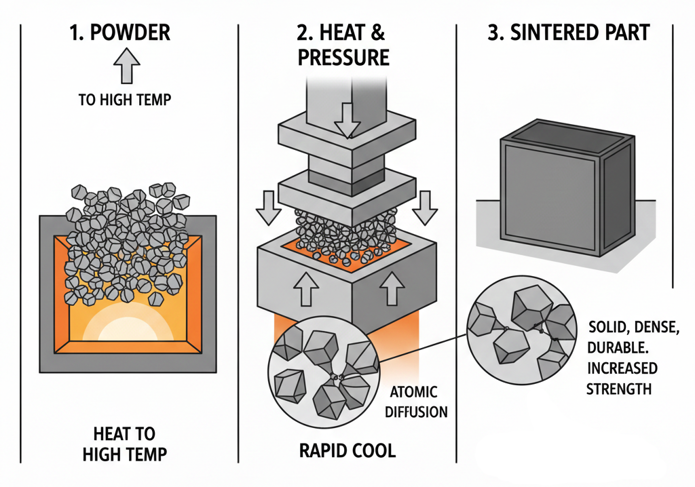
In conventional powder metallurgy, sintering is the “S” in press-and-sinter: powders are blended (often with additives/lubes), compacted in a die to shape, then sintered in a furnace to bond the particles and develop useful properties.
There are a few major flavors. Solid-state sintering happens with everything staying solid. Liquid-phase sintering intentionally creates a small amount of liquid (from one constituent or an additive) during the cycle; because atomic motion is much faster in a liquid, this can accelerate bonding and densification and can help materials that are otherwise difficult to densify. Reactive sintering is when phases react during sintering to form new products (common in advanced ceramics).
The big “control knobs” are temperature, time, particle size/distribution, compaction density, and the atmosphere (vacuum, inert, reducing, etc.). Those knobs determine how much bonding vs. densification you get, how much grain growth occurs, whether oxides get reduced or remain as barriers, and how much shrinkage (dimensional change) you need to account for.
Why use sintering at all? It’s a practical way to make parts from powders—often enabling complex shapes, useful properties, and materials that are hard to process by melting routes—while also allowing you to deliberately build in (or remove) porosity depending on what the part needs to do.