
Learning Hub
Glossary
Silicon (Si)
Silicon is a chemical element with the symbol Si and atomic number 14. It is a metalloid, meaning it has properties of both metals and nonmetals, and is the second most abundant element in Earth’s crust (after oxygen), making up about 28% by weight. Silicon plays a critical role in both nature and technology, serving as the foundation of modern electronics and materials science.
In its pure crystalline form, silicon is a hard, dark-gray, shiny solid with a metallic luster and a brittle structure similar to glass. It does not occur naturally in its pure state, but is found extensively in compounds such as silica (SiO₂) and silicates, which form the main components of sand, quartz, clay, and many rocks.
Silicon’s semiconducting properties are what make it so important in modern life. When precisely purified and doped with trace elements such as phosphorus or boron, silicon becomes the key material used in computer chips, transistors, diodes, solar cells, and microprocessors—earning it the nickname “the backbone of the digital age.” The region in California known as Silicon Valley is named after its central role in semiconductor and computer innovation.
Beyond electronics, silicon is also vital in metallurgy, construction, and chemistry. It is used in the production of alloys such as ferrosilicon, which strengthen steel and aluminum, and in the manufacture of glass, ceramics, and concrete. In polymer form, silicones (polysiloxanes) are flexible, rubber-like materials used in seals, adhesives, lubricants, medical implants, and cookware due to their stability and resistance to temperature and moisture.
Silicon Bronze
Silicon bronze is a copper-based alloy made primarily of copper and silicon, often with small amounts of manganese, iron, zinc, or other elements depending on the specific grade. It is known for its excellent corrosion resistance, good strength, toughness, weldability, and durability in marine and outdoor environments. In fastener terms, silicon bronze is one of the premium copper alloys used when hardware needs to survive moisture, weather, and salt exposure better than ordinary steel or brass.
The most common silicon bronze fastener alloy is C65100, which typically contains mostly copper with a small silicon addition. That silicon improves strength and corrosion resistance while still allowing the material to remain workable and machinable. Silicon bronze is stronger than many brasses, has better corrosion resistance than plain carbon steel, and is widely respected in marine hardware because it performs well in seawater and coastal environments.
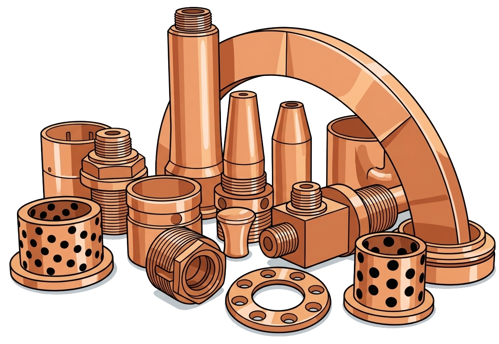
Silicon bronze is commonly used for wood screws, machine screws, bolts, nuts, washers, rivets, threaded rod, marine hardware, electrical hardware, boatbuilding fasteners, dock hardware, architectural hardware, and restoration work. It is especially common in wooden boat construction because it resists corrosion, works well with wood, and does not create the same staining or rapid deterioration problems that some other metals can cause in wet service.
One of the biggest advantages of silicon bronze is its resistance to saltwater corrosion. Stainless steel, especially 316 stainless, is also used in marine environments, but stainless can suffer from crevice corrosion in oxygen-starved wet joints. Silicon bronze is often preferred in certain marine assemblies because it can remain stable in damp wood, bilge areas, submerged hardware, and other environments where stainless may not always be ideal.
Silicon bronze is also relatively galvanically compatible with other copper-based materials, such as bronze and brass. This matters in marine assemblies because dissimilar metals connected in saltwater can create galvanic corrosion. For example, using stainless steel fasteners with bronze fittings can sometimes accelerate corrosion in the less noble material. Silicon bronze fasteners are often a better match for bronze hardware.
Mechanically, silicon bronze is not as strong as alloy steel or many stainless steel fasteners, so it is not usually chosen for high-strength structural bolting where tensile strength is the primary requirement. Its value is in the balance of moderate strength, excellent corrosion resistance, non-sparking behavior, good appearance, and long-term durability. It also develops a natural bronze patina over time, which can be desirable in architectural, marine, and restoration applications.
Silicon bronze should not be confused with naval brass. Naval brass is mostly copper and zinc with a small amount of tin, while silicon bronze is primarily copper with silicon as the key alloying addition. Both are used in marine hardware, but silicon bronze is generally considered the more premium choice for many boatbuilding and seawater fastener applications.
Silicon Carbide (SiC)
Silicon carbide (SiC) is a compound of silicon and carbon that is recognized for its exceptional hardness, thermal stability, and chemical resistance. While it occurs naturally in extremely rare mineral forms such as moissanite, it is primarily produced synthetically and has become one of the most important advanced ceramics in modern industry. Its unique combination of properties allows it to be used both as a high-performance structural material and as a semiconductor in power electronics.

Silicon carbide’s strength comes from its crystalline structure, in which silicon and carbon atoms alternate in strong covalent bonds. This gives it a hardness of about 9–9.5 on the Mohs scale, placing it just below diamond and cubic boron nitride. Unlike many ceramics, it also has high thermal conductivity, which allows it to transfer heat efficiently. SiC can withstand temperatures above 1,600 °C (2,912 °F) without losing strength and is highly resistant to oxidation, corrosion, and chemical attack. In addition, certain forms of SiC function as semiconductors, offering a wide bandgap, high voltage resistance, and efficiency that make them highly valuable in advanced electronics.
The material is typically manufactured through the Acheson process, in which a mixture of silica sand (SiO₂) and carbon, often from petroleum coke, is heated in an electric resistance furnace at temperatures between 2,000–2,500 °C (3,632–4,532 °F). The reaction produces silicon carbide crystals, which can then be ground into abrasive powders, sintered into ceramic components, or grown into wafers for use in electronics.
Applications of silicon carbide are diverse. Its hardness makes it ideal for abrasives such as grinding wheels, sandpapers, and polishing compounds, as well as cutting tools that must endure high wear. In ceramics and refractories, it is used for furnace linings, kiln shelves, and crucibles that must tolerate high heat. In the electronics sector, silicon carbide is increasingly important as a semiconductor material for high-performance power devices used in electric vehicles, solar inverters, and high-frequency systems. The automotive industry uses SiC in performance brake discs, clutches, and heat exchangers, while its lightweight hardness makes it suitable for armor in protective vests and vehicles.
The advantages of silicon carbide include its extreme hardness and wear resistance, ability to withstand very high operating temperatures, chemical stability, corrosion resistance, and efficiency in conducting both heat and electricity in specialized applications. However, it does have limitations. It is brittle compared to metals and can fracture under sudden impact or shock loads. Production costs, particularly for semiconductor-grade SiC, are relatively high. Additionally, its hardness requires specialized equipment and processes for shaping, machining, and finishing. Despite these challenges, silicon carbide remains an essential material for industries demanding high performance in extreme environments.