
Learning Hub
Glossary
Phosphating
Phosphating is a chemical surface-treatment process that forms a thin, crystalline phosphate coating on steel, iron, zinc, or other metal surfaces. The coating is created by immersing or spraying the metal with a phosphate solution that reacts with the surface and converts part of it into an insoluble layer of phosphate crystals. Rather than simply being painted onto the metal, the coating is chemically bonded to the surface through a conversion reaction.
Phosphate coatings are commonly used to improve corrosion resistance, provide a better surface for paint or other coatings, reduce friction, assist with break-in between moving parts, and help retain lubricants or oils. The coating itself usually provides only moderate corrosion protection, so it is often combined with oil, wax, paint, sealers, or another protective finish.
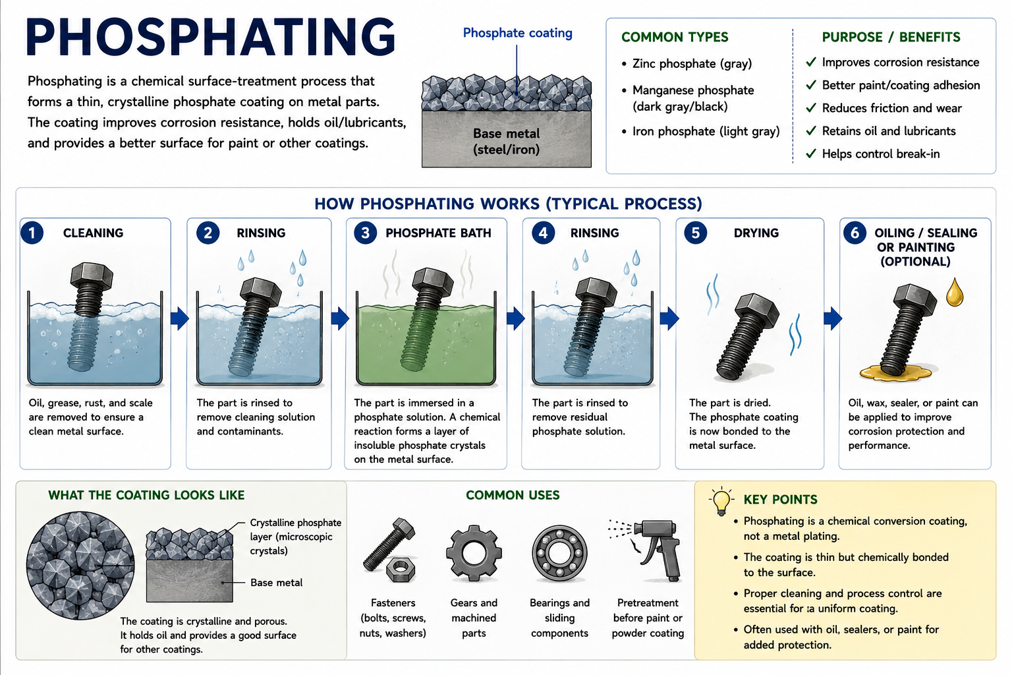
The most common types are zinc phosphate, manganese phosphate, and iron phosphate. Zinc phosphate is widely used as a pretreatment before painting or powder coating because its crystalline surface improves coating adhesion and corrosion resistance. Manganese phosphate produces a heavier, more wear-resistant coating that can hold lubricants, making it useful for gears, bearings, firearms components, and other sliding or moving parts. Iron phosphate generally forms a lighter coating and is often used as an economical pretreatment before painting.
The process usually begins with cleaning the metal to remove oil, grease, rust, scale, and other contamination. The part is then exposed to the phosphate solution under controlled conditions of temperature, concentration, and time. After the coating forms, the part may be rinsed, sealed, oiled, painted, or otherwise finished. Surface preparation is critical because dirt or corrosion can prevent the coating from forming evenly.
In fastener manufacturing, phosphating is often used on bolts, screws, nuts, and washers to provide a dark gray or black appearance, improve oil retention, reduce galling, and help control friction during installation. Because phosphate coatings can affect the relationship between tightening torque and clamp load, lubricants or sealers applied over the coating must be carefully controlled when consistent fastener performance is required.
Phosphating is different from electroplating because it does not deposit a separate metal layer using electrical current. It is also different from painting because it chemically converts the metal surface itself. In practical terms, phosphating creates a rough, porous, chemically bonded layer that helps the metal hold lubricants and provides a better foundation for additional protective coatings.
AKA: Phosphate Conversion Coating