
Learning Hub
Glossary
Cast Alloy Nut
A cast alloy nut is a fastener created by pouring a molten metal alloy into a mold. Two of the most commonly used types are made from zinc and aluminum, each having distinct properties for specific applications. The general manufacturing process involves melting the metal and then casting it into a mold, such as through die casting or sand casting. Die casting is a high-pressure, high-volume method that produces accurate parts with smooth finishes, while sand casting is a lower-cost, more versatile method often used for complex shapes. Following casting, the nuts may undergo further processes, like threading and machining, to achieve their final specifications.
Zinc alloy nuts, which are often die-cast, offer cost-effectiveness and good corrosion resistance. Their properties prevent them from galling or "freezing" onto mating threads, a significant advantage in many fastening applications. They are frequently used for panel mounting and as thumb or wing nuts in various consumer and hardware products.
Alternatively, aluminum alloy nuts are valued for their exceptional strength-to-weight ratio, making them significantly lighter than their steel counterparts. They naturally form a protective oxide layer that gives them excellent corrosion resistance. Although not as strong as steel, they are highly durable and reliable for many uses. Their applications range from weight-sensitive items like automotive wheel lug nuts and aerospace components to consumer goods and electronics where light weight and corrosion resistance are needed.
The applications for cast alloy nuts are diverse due to their combination of strength, light weight, and corrosion resistance. In the automotive industry, lightweight aluminum wheel lug nuts can improve a vehicle's performance by reducing unsprung weight. The electronics sector benefits from cast aluminum nuts' high thermal conductivity, which helps dissipate heat in connectors and other components. Furthermore, cast alloy barrel nuts are a popular choice in the furniture industry for assembly, while corrosion-resistant zinc alloy nuts are commonly used in appliances and general hardware.
Continuous Cast Alloys
Continuous cast alloys are metal alloys produced by a casting process in which molten metal is poured into a cooled mold and solidified continuously into a long, uniform shape such as bar, rod, tube, billet, slab, strip, or plate. Instead of casting one individual piece at a time, continuous casting creates a steady length of material that can later be cut, machined, forged, rolled, extruded, or otherwise processed into finished components.
In this process, molten alloy flows into a water-cooled mold where the outside surface begins to solidify. As the partially solidified metal is drawn out of the mold, more molten metal is added behind it, creating a continuous strand. The material is then cooled further, straightened if needed, and cut to length. Because the process is controlled and repeatable, continuous cast material can offer consistent chemistry, grain structure, density, and mechanical properties throughout the length of the product.
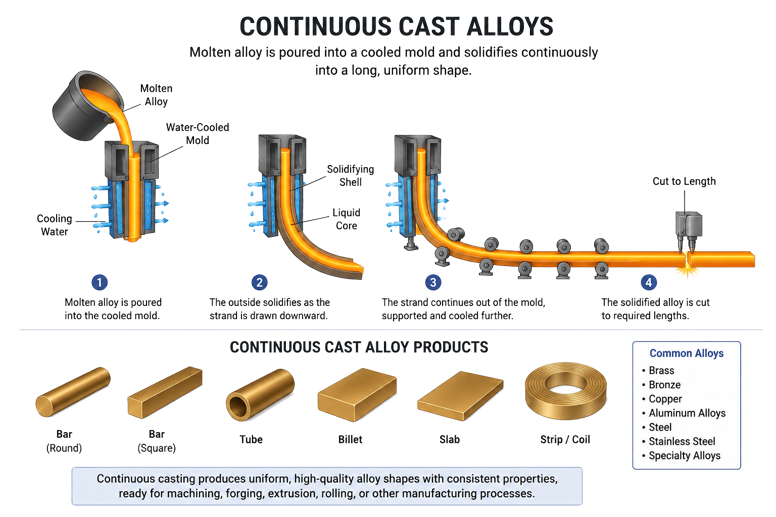
Continuous cast alloys are common in copper alloys, brass, bronze, aluminum alloys, steel, stainless steel, and specialty metals. In copper-based alloys, continuous casting is often used to make bar stock, tube stock, and shaped sections for bushings, bearings, gears, wear plates, electrical components, marine hardware, valve parts, fittings, and machined industrial components.
The advantage of continuous casting is that it can produce sound, uniform material with less waste than some older casting methods. It also reduces the need for repeated remelting or individual mold pouring. Compared with sand casting, for example, continuous cast material generally has better dimensional consistency and a more uniform internal structure. Compared with fully wrought material, it may offer good machinability and availability in larger or specialty shapes.
In fastener and industrial manufacturing, continuous cast alloys may be used as starting stock for machined parts, threaded inserts, bushings, spacers, nuts, washers, wear components, and custom per-print parts. The material is not usually a finished fastener by itself; it is a controlled alloy form that can be cut and machined into finished components.