Learning Hub
Glossary
Cross Drilling
Cross drilling is a machining operation where you drill a hole perpendicular (or at a defined angle) to the main axis of a part—so the new hole intersects an existing bore, passage, or the part’s centerline. In industrial components it’s most often used to create a cross-hole for fluid flow, locking, or pinning.
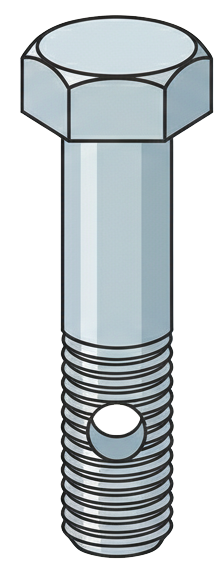
In fasteners and hardware, cross drilling usually means a hole drilled through a bolt, stud, or pin so you can install a cotter pin, safety wire, or roll pin—a simple way to keep a nut from backing off or to retain a pin in service. You’ll see it on clevis pins, castle-nut applications, and some critical bolted joints where positive locking is required.
In fluid and hydraulic parts, cross drilling is used to connect internal passages—like drilling a transverse port that intersects an axial bore—then sometimes plugging the drill entry points to create a hidden internal flow path. This is common in manifolds, valve bodies, and gun-drilled components, and it’s why you’ll see threaded plugs or pressed-in balls at what look like “random” spots on a block.
The main engineering concerns are alignment and breakout, burr control where the holes intersect, and the effect of the hole on strength and fatigue (a cross-hole is a stress concentrator). That’s why cross drilling often comes with requirements on edge distance, hole diameter tolerance, deburring/chamfering, and inspection—especially for parts in cyclic load or pressure service.