
Learning Hub
Glossary
Turnbuckle
A turnbuckle is an in-line tensioning device used in the fastener/rigging world to adjust and maintain tension in cable, wire rope, rod, chain, and similar brace or tie assemblies. It is built around a central turnbuckle body with internal threads and two end fittings, typically configured so that one end has right-hand threads and the other has left-hand threads. When you rotate the body, the ends move simultaneously—either drawing together or spreading apart—which changes the effective assembly length and allows precise tensioning and alignment.
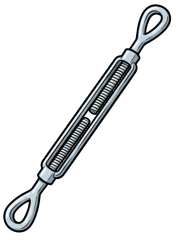
Turnbuckles are identified by their opposite-hand (RH/LH) threaded ends, and they come in common body styles including open body, closed body, and hook body designs, selected based on required strength, ease of inspection, and exposure to corrosion. Many turnbuckles incorporate wrench flats, holes, or a center feature that provides leverage so the body can be turned during adjustment. End fittings are selected for the connection method and security level, with typical configurations including hook–hook (quick attachment, but generally not preferred for critical lifting unless specifically rated and secured), eye–eye (more secure and common for structural bracing), and jaw–jaw / clevis–clevis (pinned connections that handle alignment well and are often favored in vibration-prone environments), along with mixed combinations such as hook–eye and jaw–eye.
In industrial use, turnbuckles are widely applied for bracing and alignment on structural steel, pipe racks, conveyors, and mezzanines; for tensioning guy wires and support cables; and in marine/utility rigging, fencing, and overhead support systems—especially where periodic adjustment or re-tensioning is expected. They are commonly manufactured from carbon steel with protective finishes such as zinc plating or hot-dip galvanizing, and from stainless steel when corrosive, chemical, marine, or washdown conditions demand higher corrosion resistance; specialty coatings and materials may be used for particularly aggressive atmospheres.
Turnbuckles are typically specified by thread size (UNC/UNF or metric), take-up length (the adjustment range), and end fitting type, and in critical applications the Working Load Limit (WLL), proper thread engagement, and any applicable rigging requirements should be confirmed. After adjustment, a turnbuckle should be secured to prevent rotation—using jam nuts, safety wire, clips, or built-in locking features—because vibration and cyclic loading can back the assembly off, particularly in structural bracing and overhead installations.