
Learning Hub
Glossary
Hoist Ring
A hoist ring (often a swivel hoist ring or swivel lifting ring) is a rated lifting attachment point that threads into a tapped hole and provides a ring-shaped connection for hooks, shackles, or slings so a load can be lifted or moved. Unlike a fixed eye, a hoist ring is designed to articulate so the ring can align with the direction of pull, helping the lifting point maintain capacity under angular loading and reducing harmful side-loading on the threaded shank.
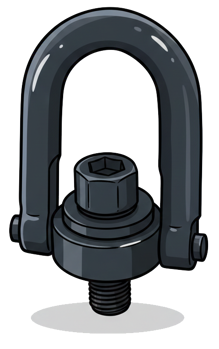
Most hoist rings are built with a base (threaded body) and a pivoting/swiveling ring assembly. In common “swivel hoist ring” designs, the ring can swivel (often 360°) and pivot (often ~180°) so it self-orients as the rigging angle changes. Because the angle of loading affects the effective load on rings and swivels, proper selection and rigging angles matter even when the hardware is rated.
Hoist rings are typically supplied as engineered, marked lifting devices with a published Working Load Limit (WLL) and installation requirements. Industry guidance tied to ASME B30.26 (Rigging Hardware) commonly calls out that swivel hoist rings should be durably marked (e.g., manufacturer identification and rated load, and often an installation torque value) so users can verify they’re using the correct product and installing it correctly.
A practical distinction: compared with a shoulder eyebolt, swivel hoist rings are generally favored when the load may rotate, shift, or pull at an angle, because the ring can align to the load rather than being forced into a damaging side-load condition.