
Learning Hub
Glossary
Fahrenheit (°F)
Fahrenheit (°F) is a temperature scale you’ll still see a lot in U.S.-based industrial environments—especially where equipment, controls, or specs were designed around U.S. customary units (legacy ovens, HVAC, boilers, some chemical/process equipment, older QC procedures, certain customer drawings, etc.). It’s perfectly usable in serious engineering work—just be clear whether you’re talking absolute temperature, temperature differences, or setpoints.
What Fahrenheit means
Fahrenheit is a relative temperature scale with these classic anchor points:
- 32 °F = water freezes
- 212 °F = water boils (at standard atmospheric pressure)
- The span between them is 180 degrees, which is why Fahrenheit steps feel “smaller” than Celsius steps.
Key consequence for tolerance and control:
- 1 °F = 5/9 °C ≈ 0.5556 °C (so a ±5 °F tolerance is roughly ±2.78 °C).
Conversion formulas you’ll actually use on the plant floor
From NIST (exact):
- °C = (°F − 32) / 1.8
- K = (°F − 32) / 1.8 + 273.15
Quick anchors:
- 70 °F ≈ 21.1 °C (comfortable room)
- 100 °F ≈ 37.8 °C (hot day / warm process water)
- −40 °F = −40 °C (the famous crossover)
Fahrenheit in process control & metrology
In industrial documents, people often mix these up, so it’s worth being explicit:
- Setpoint / actual temperature: “Tank held at 140 °F.”
- Temperature rise (ΔT): “Outlet is +25 °F hotter than inlet.”
A degree Fahrenheit used as an interval (a temperature difference) is not the same thing as a Fahrenheit reading with an offset from a reference point. NIST even separates “degree Fahrenheit (temperature)” vs “degree Fahrenheit (temperature interval)” in conversion tables—because the math differs (the offset disappears for intervals).
Absolute temperature equivalents (when formulas need absolute):
- Absolute zero is −459.67 °F.
- The absolute scale paired with Fahrenheit-sized steps is Rankine (°R):
°R = °F + 459.67.
In practice: if you’re doing anything like ideal gas calculations, compressible flow, some heat transfer relations, etc., you’ll often see °R (or Kelvin in SI-land) used to keep the physics honest.
Who it was named after
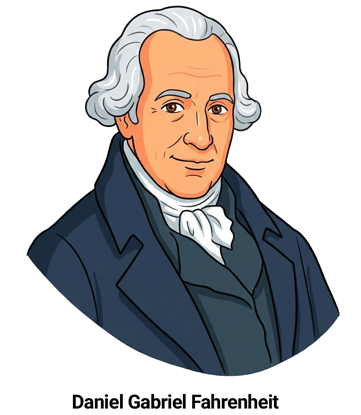
The Fahrenheit scale is named after Daniel Gabriel Fahrenheit (1686–1736)—a maker of scientific instruments best known for developing the Fahrenheit temperature scale (1724) and inventing the mercury-in-glass thermometer (1714).