
Learning Hub
Glossary
Celsius (°C)
Celsius (°C) is a practical temperature scale used for process control, inspection, calibration, and documentation—especially anywhere you’re reading temperature from thermocouples, RTDs (Pt100/Pt1000), IR sensors, ovens/furnaces, chillers, plating lines, wash tanks, heat treat, injection molding, or HVAC.
What Celsius actually means
Celsius is a relative temperature scale tied tightly to the SI temperature unit (kelvin, K):
- A temperature interval of 1 °C is exactly the same size as 1 K (so a “±2 °C tolerance” is the same magnitude as “±2 K” for differences).
- The conversion is exact by definition:
K = °C + 273.15 and °C = K − 273.15.
That means Celsius is basically “Kelvin with a convenient offset” so humans don’t have to talk about room temperature being ~293 K. (Engineers still use kelvin when formulas require absolute temperature—gas laws, some material models, radiative heat transfer, etc.)
Why it shows up everywhere in specs and plants
Industrial documentation loves °C because it maps cleanly to real operations:
- Setpoints & control loops: Your PID setpoint is often in °C because it’s intuitive (e.g., 82 °C wash, 200 °C cure, 980 °C austenitize).
- Tolerances: “Hold 180 °C ± 3 °C” is easy to interpret on the floor, while still being SI-consistent (same step size as K).
- Calibration & metrology: In traceable temperature calibration, the real backbone is kelvin, but results are commonly reported in °C for usability. The formal relationship is explicitly defined as t = T − 273.15 K (Celsius temperature t from thermodynamic temperature T).
The “water points” (helpful mental anchors, not how labs define it today)
You’ll still hear the classic reference points:
- 0 °C ≈ freezing/melting point of water
- 100 °C ≈ boiling point of water (at ~1 atm)
That’s a great shop-floor intuition, but modern temperature standards are realized via calibrated instruments and SI definitions (not “a pot of water on a hot plate”).
Who it was named after
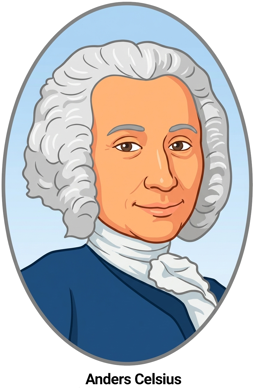
The Celsius scale is named after Anders Celsius (1701–1744), a Swedish astronomer who proposed a centigrade temperature scale in 1742 (the original version was inverted compared to today’s).