
Learning Hub
Glossary
Thread Pitch
Thread pitch is the distance between corresponding points on adjacent threads of a screw, bolt, or nut. In simple terms, it measures how far a fastener will travel linearly in one complete turn.
In metric threads, thread pitch is expressed directly in millimeters (mm). For example, an M10 × 1.5 bolt has a pitch of 1.5 mm, meaning the bolt advances 1.5 mm with each full revolution.
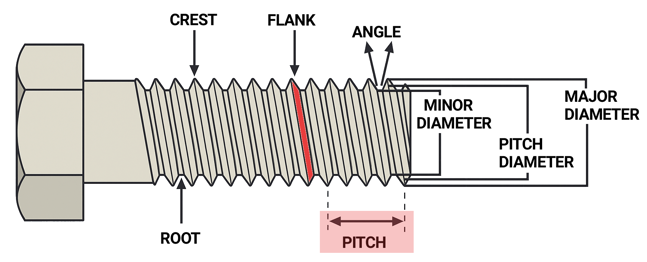
In the inch-based Unified Thread Standard (UTS) used in the U.S., pitch is usually described indirectly as threads per inch (TPI). For instance, a 1/4-20 UNC bolt has 20 threads per inch, which corresponds to a pitch of 1/20 = 0.050 inches.
Pitch is one of the key dimensions that determines whether threaded parts will mate properly. A mismatch in thread pitch, even if the diameter looks correct, will prevent proper engagement and can cause damage, stripping, or failure.
Engineers carefully specify thread pitch depending on the application. Coarse pitches (fewer threads per inch or larger millimeter pitch) are stronger and faster to assemble, while fine pitches (more threads per inch or smaller millimeter pitch) allow for greater precision, better load distribution, and stronger resistance to loosening under vibration.