
Learning Hub
Glossary
Threads Per Inch (TPI)
Threads per inch (TPI) is a measurement used to describe the density of threads on a screw, bolt, or nut in the imperial (inch-based) system. It indicates how many threads are present in one inch of length along the fastener’s shank.
For example, if a screw has 20 threads per inch, that means you would count 20 complete thread peaks along a one-inch segment of the fastener. A higher TPI means finer threads (closer together), while a lower TPI means coarser threads (fewer per inch and deeper).
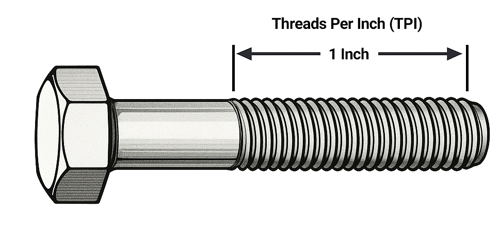
TPI is part of the Unified Thread Standard (UTS), which defines thread series such as:
- UNC (Unified National Coarse): Fewer threads per inch; stronger, faster to assemble, and less likely to strip—commonly used in general applications.
- UNF (Unified National Fine): More threads per inch; provides better tension control, greater holding strength in thin materials, and more resistance to vibration.
- UNEF (Unified National Extra Fine): Very high TPI, used for precision instruments or thin-walled components.
For example:
- A ¼-20 UNC bolt has a ¼-inch major diameter and 20 threads per inch (coarse).
- A ¼-28 UNF bolt has the same diameter but 28 threads per inch (fine).
In contrast, the metric system expresses thread density as the pitch, which is the distance between adjacent threads, measured in millimeters (e.g., M6 × 1.0 has a 1.0 mm thread pitch).