
Learning Hub
Glossary
Swaging Machine
A swaging machine is a piece of industrial equipment that permanently reshapes metal by squeezing it—usually with segmented dies—so the part’s diameter is reduced, the shape is formed, or two parts are mechanically locked together. The key idea is plastic deformation: you’re not cutting metal away, you’re forcing it to flow into a new geometry under very high compressive force.
In the rigging world (where you’ve been living with Flemish eyes and ferrules), a swaging machine is what compresses a ferrule/sleeve onto wire rope to create a permanent termination. The machine forces the sleeve to collapse into the rope, gripping the rope body and tails with a controlled amount of deformation. Done correctly—with the right sleeve material, die size, press sequence, and verification—swaging turns “a loop of rope and a sleeve” into a rated, repeatable connection that can survive shock, bending, and real shop abuse.
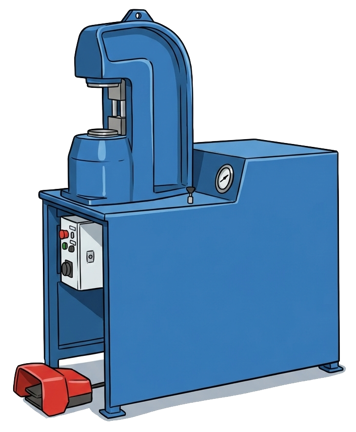
Mechanically, swaging machines come in a few common flavors. Rotary (radial) swagers use rapidly hammering dies that strike inward many times per second, great for forming tubing ends, reducing diameter, or making tapered sections. Linear/hydraulic swaging presses (very common for wire rope sleeves) use a powerful hydraulic ram to drive dies closed in a controlled stroke. You’ll also see related “swage-like” systems—crimpers for hose fittings, and roll swagers that use rollers instead of dies—different machines, same fundamental concept: cold-forming a sleeve or end fitting so it becomes one with the base material by force.
In industrial production, swaging is popular because it’s fast, repeatable, and strong with minimal heat input (often a cold-working process). It’s used for wire rope terminations, cable assemblies, electrical lugs/ferrules, tube-end forming (like flares and beads), automotive and aerospace linkages, and many “make-it-one-piece” assemblies. The tradeoff is that quality is heavily dependent on process control: correct tooling, proper setup, and inspection (diameter checks, go/no-go gauges, proof testing where required). When swaging goes wrong, failures are usually traceable to wrong die/sleeve combo, under- or over-compression, misalignment, damaged rope/tube, or poor calibration.