
Learning Hub
Glossary
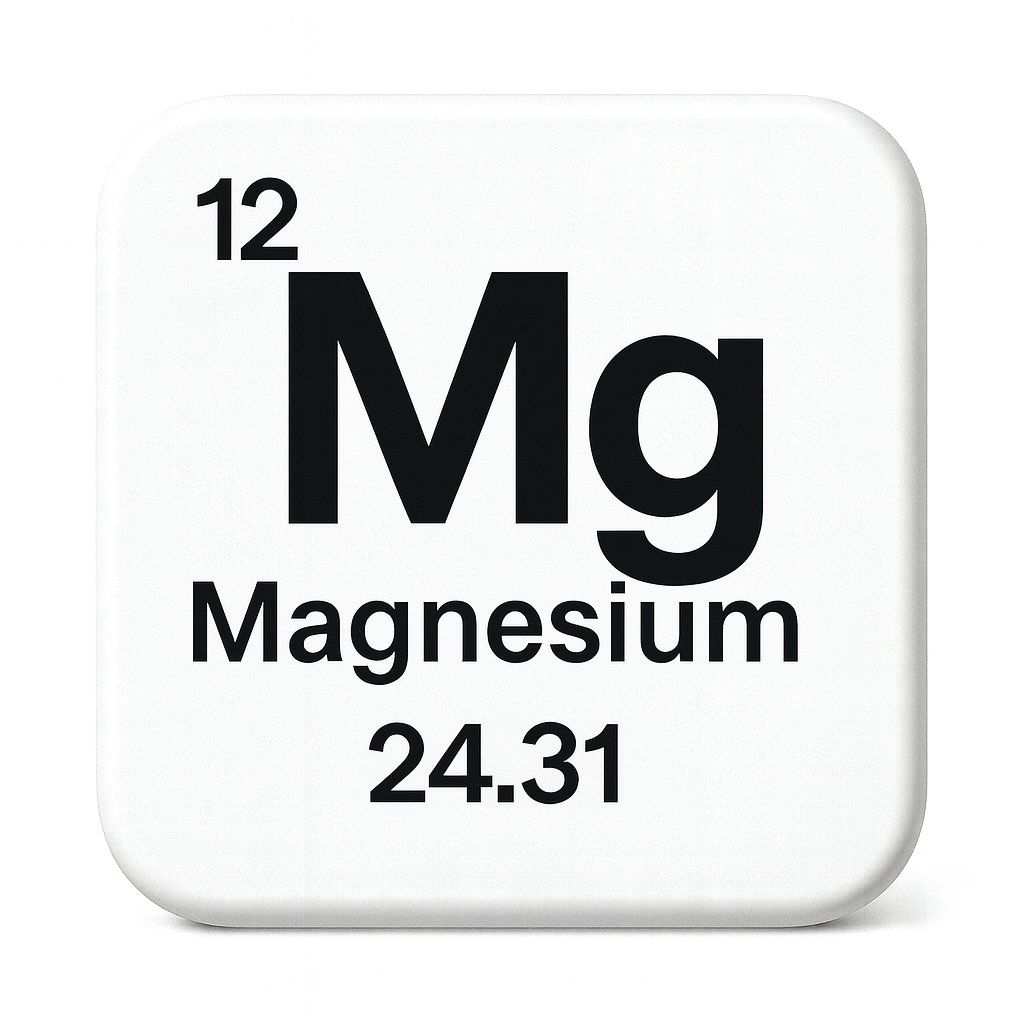
Magnesium (Mg)
Magnesium is a silvery-white metallic element with the chemical symbol Mg and atomic number 12. It is a lightweight, strong, and reactive metal that plays a crucial role in both industrial applications and biological systems. As the eighth most abundant element in Earth’s crust and a key component of seawater, magnesium is one of the most important metals for modern manufacturing and life processes alike.
In its pure metallic form, magnesium is one-third lighter than aluminum, making it one of the lightest structural metals. It combines low density, high strength-to-weight ratio, and excellent machinability, which makes it ideal for aerospace, automotive, and electronics industries. Magnesium alloys are often used to produce aircraft parts, transmission housings, laptop casings, and lightweight tools, helping reduce overall weight while maintaining durability.
Chemically, magnesium is highly reactive, especially in finely divided form. It readily reacts with oxygen to form magnesium oxide (MgO), a white powder that emits a bright white flame when the metal burns—this characteristic has made magnesium famous in fireworks, flares, and photographic flashes. When exposed to air, it forms a thin protective oxide layer that prevents rapid corrosion.
Magnesium is also an essential biological element—it is the fourth most abundant mineral in the human body and is necessary for over 300 enzymatic reactions, including energy production, muscle contraction, nerve function, and protein synthesis. It forms the central atom in chlorophyll, the green pigment that allows plants to capture sunlight during photosynthesis.
Common industrial magnesium compounds include magnesium oxide (MgO) used in refractories and insulation, magnesium hydroxide (Mg(OH)₂) used as a flame retardant and antacid, and magnesium sulfate (Epsom salt) used in medicine and agriculture.
Magnesium is typically extracted from magnesite (MgCO₃), dolomite (CaMg(CO₃)₂), and sea water, where it is separated through electrolysis or thermal reduction processes.
Magnesium Oxide (MgO)
Magnesium oxide (MgO) is a white, crystalline, inorganic compound formed by combining magnesium (Mg) and oxygen (O₂). It is a highly stable, non-flammable, and refractory material, meaning it can withstand extremely high temperatures without breaking down. Magnesium oxide occurs naturally as the mineral periclase, but it is most commonly produced synthetically by heating magnesium carbonate (MgCO₃) or magnesium hydroxide (Mg(OH)₂) until they decompose, releasing carbon dioxide or water.

When heated, magnesium reacts with oxygen to form magnesium oxide: 2 Mg + O₂ → 2 MgO
This exothermic reaction produces an intense white flame — a signature of magnesium combustion. The resulting MgO is a fine white powder or solid with a high melting point (~2,852°C or 5,166°F), making it useful in industrial furnaces, crucibles, kilns, and refractory bricks that line high-temperature equipment.
Magnesium oxide has a wide range of uses:
- In metallurgy, it serves as a refractory material and flux, protecting metals from oxidation.
- In construction, MgO boards are used as fire-resistant and mold-resistant alternatives to drywall or cement board.
- In environmental applications, it’s used to neutralize acidic wastewater and flue gases.
- In electrical and thermal insulation, MgO is used inside heating elements (such as in toasters and ovens) due to its high dielectric strength and ability to conduct heat while insulating electrically.
Magnesium oxide also reacts slowly with water to form magnesium hydroxide (Mg(OH)₂), a process known as hydration: MgO + H₂O → Mg(OH)₂