
Learning Hub
Glossary
Fretting
Fretting is a type of wear and surface damage that occurs when two contacting materials experience repeated small-amplitude oscillatory motion—typically vibration or micro-sliding—under load. Even though the movement between the surfaces is very slight (often less than 100 microns), it causes abrasion, oxidation, and material degradation over time.
This phenomenon commonly occurs in bolted joints, splines, bearings, shafts, and structural assemblies, where surfaces are pressed together but subjected to vibration or cyclic stress. As the materials rub microscopically, the protective oxide films are repeatedly broken and re-formed, producing fine metallic debris that oxidizes quickly. This results in reddish-brown or black debris (often called fretting corrosion) and pitted, roughened contact surfaces.
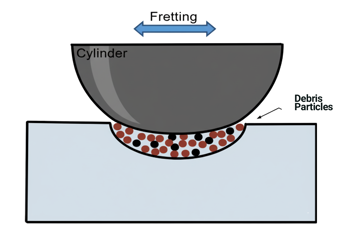
Fretting can lead to serious problems such as loss of preload in fasteners, fatigue cracking, surface weakening, and joint loosening. It’s especially problematic in aerospace, automotive, and machinery applications where vibration and precision contact are unavoidable.
Preventing fretting involves minimizing micro-movements and maintaining stable contact conditions—often through increased clamp load, surface coatings, lubricants, or using materials with higher hardness or corrosion resistance.