
Learning Hub
Glossary
Ductile Fracture
A ductile fracture is a type of material failure that occurs when a material is subjected to stress and undergoes significant plastic deformation before breaking. Unlike brittle fracture, which happens suddenly with little warning, ductile fracture is a more gradual process where the material stretches, bends, or elongates as it absorbs energy prior to failure.
The process of ductile fracture typically occurs in stages. First, the material deforms elastically (reversible stretching), then plastically (permanent deformation). As the load increases, localized thinning or “necking” develops at the weakest point. Microscopic voids form and grow inside the material, eventually coalescing into cracks. The final break often occurs along a slanted plane, and the fracture surface usually appears rough and fibrous rather than flat and smooth.
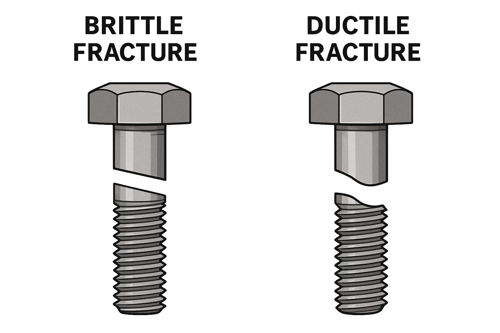
One of the key characteristics of ductile fracture is the warning it provides before failure. Because the material shows visible signs of distortion—such as stretching, necking, or elongation—engineers can often detect and address the problem before catastrophic collapse. This makes ductile materials safer for critical applications.
Ductile fracture is commonly observed in materials such as mild steel, aluminum, copper, and many alloys. It is generally considered a desirable failure mode in engineering because it indicates toughness, energy absorption, and resistance to sudden breakage.