
Learning Hub
Glossary
Cleat
A cleat is a small attached piece used to secure, support, align, reinforce, or hold another part in position. It is not usually a fastener by itself in the same sense as a bolt, screw, or nut, but rather a supporting or connecting component that helps stabilize or retain something within an assembly.
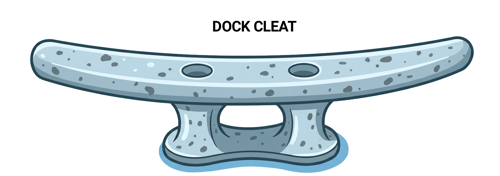
The exact meaning of cleat depends on the application. In general industrial and construction use, a cleat may be a strip, bracket, angle, or projecting piece that is fastened to a surface or structural member to provide support or create a point of attachment. In structural assemblies, cleats are often used to connect members together or help transfer load. In other applications, a cleat may simply act as a retaining piece, stop, brace, or mounting aid.
In practical terms, a cleat is best understood as a hardware or structural component that helps hold, connect, or position something else. Because the term is broad, it is commonly paired with the type of product or use it describes, such as a mounting cleat, angle cleat, or dock cleat.
Corrosion Nucleation
Corrosion nucleation is the initial stage in the corrosion process where the very first microscopic sites of corrosion begin to form on a metal surface. At this stage, the metal is still mostly intact, but localized regions—often defects, impurities, scratches, grain boundaries, or inclusions—become energetically favorable spots where corrosion reactions can start.
When a metal is exposed to an aggressive environment (such as moisture, salts, acids, or other electrolytes), small electrochemical cells form on the surface. Certain areas act as anodic sites, where metal atoms begin to lose electrons and dissolve, while surrounding areas act as cathodic sites, where reduction reactions occur. This uneven distribution of activity causes specific points to become the “nuclei” or seeds of corrosion.
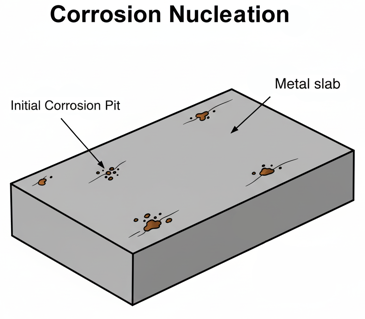
Nucleation is critical because it determines how corrosion will progress. If the nucleation sites remain few and isolated, corrosion may advance slowly and be easier to manage. But if many nuclei form across the surface, corrosion spreads more rapidly, leading to generalized damage. In other cases, nucleation may be highly localized, giving rise to pitting corrosion, crevice corrosion, or other aggressive localized attack that can cause sudden failures.
The factors influencing corrosion nucleation include the material’s microstructure, surface condition, applied stresses, environmental chemistry, and temperature. Understanding and controlling this stage is important in corrosion prevention because once nucleation sites establish themselves, corrosion tends to accelerate and propagate outward.