
Learning Hub
Glossary
CNC Lathe
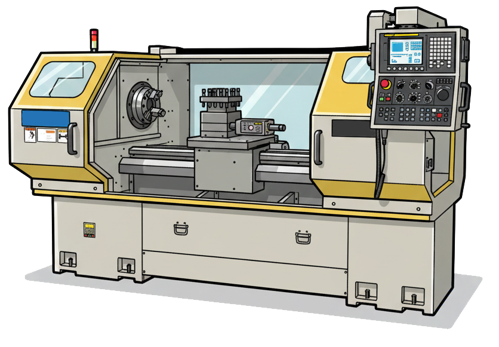
A CNC lathe is a computer-controlled machine tool used to shape metal, plastic, and other materials by rotating the workpiece against a cutting tool. “CNC” stands for Computer Numerical Control, meaning the machine’s movements, tool positions, spindle speeds, and cutting operations are all controlled by a programmed set of instructions rather than manual operation.
How a CNC Lathe Works
A cylindrical workpiece is clamped into a rotating spindle. As it spins, the CNC system moves cutting tools along precise, pre-programmed paths to remove material. This allows the machine to create symmetrical, round, or tapered parts with very high accuracy.
Common Parts Made on CNC Lathes
CNC lathes are widely used to manufacture:
- Bolts, screws, and threaded fasteners
- Pins, shafts, bushings, and spacers
- Fittings, couplings, and hydraulic components
- Automotive and aerospace parts
- Precision industrial components
Anything round, concentric, or cylindrical often comes off a CNC lathe.
Why CNC Lathes Are Important in Industrial Manufacturing
- Precision: Can hold extremely tight tolerances.
- Repeatability: Produces identical parts consistently in high volume.
- Speed & Efficiency: Automatic operation reduces labor and increases throughput.
- Complexity: Modern CNC lathes (turning centers) can perform drilling, tapping, milling, and even multi-axis machining in a single setup.
Turning Center vs. Basic CNC Lathe
A simple CNC lathe mainly turns and faces material.
A CNC turning center is more advanced, often featuring:
- Live tooling (milling + turning)
- Sub-spindles
- Automatic bar feeders
- Y-axis movement
- Tool turrets with multiple tools
These machines can produce finished, complex parts in one cycle.
Fastener Industry Tie-In
Many fasteners—especially custom bolts, studs, bushings, standoffs, precision shafts, and specialty components—are produced or finished on CNC lathes. The machine’s ability to produce exact diameters, threads, and surface finishes makes it a core tool in fastener manufacturing and the broader industrial machining world.
CNC Mill
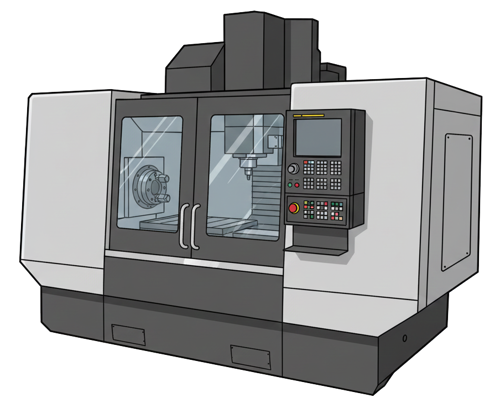
A CNC mill (Computer Numerical Control milling machine) is a programmable machine tool that uses rotating cutting tools to remove material from a solid workpiece, creating precise shapes, cavities, surfaces, and features. Unlike a CNC lathe—which rotates the workpiece—a CNC mill keeps the part stationary (or moves it in controlled axes) while the cutting tool rotates and moves along multiple directions to carve out geometry.
How a CNC Mill Works
A CNC mill uses a high-speed rotating cutter to remove material as the tool moves along programmed paths called “toolpaths.” The CNC controller precisely manages:
- Tool movement (X, Y, Z axes and more)
- Spindle speed
- Tool changes
- Feed rate
- Depth of cut
This allows the machine to create both simple and extremely complex shapes with high accuracy.
What CNC Mills Make
CNC mills produce parts that require flat surfaces, slots, pockets, angles, contours, and detailed geometric shapes, such as:
- Brackets, housings, and mounting plates
- Mold cavities and dies
- Precision machine components
- Engine and transmission parts
- Fixtures, tooling, and jigs
- Custom fastener heads, sockets, and drive features
- Complex prismatic parts
Anything requiring 3D shaping or precise surface geometry is a candidate for CNC milling.
CNC Mill Types
Vertical CNC Mill (VMC)
- Most common
- Spindle is vertical
- Great for most machining tasks
Horizontal CNC Mill (HMC)
- Spindle is horizontal
- Better for deep cavities, chip evacuation, and production runs
5-Axis CNC Mill
- Can rotate and tilt the part or tool
- Allows machining from multiple angles in one setup
- Ideal for aerospace, molds, medical components, and complex geometry
Why CNC Mills Matter in Industrial Manufacturing
- Precision: Achieves exceptionally tight tolerances
- Versatility: Cuts metals, plastics, composites, and more
- Complexity: Creates features that lathes or manual machines cannot
- Automation: Multi-tool carousels allow complete machining in one cycle
- Repeatability: Perfect for production runs and prototypes
Fastener Industry Connection
CNC mills are used to machine:
- Custom bolt heads
- Socket drives (hex, Torx®, square)
- Washers and spacers
- Thread reliefs and undercuts
- Complex specialty fasteners and fittings
- Tooling and dies used to manufacture fasteners
While CNC lathes handle the “round” world of manufacturing, CNC mills create the flat, angled, contoured, or geometric features that lathes can’t produce.