
Learning Hub
Glossary
Anodized Fasteners
An Anodized Fastener is a screw, bolt, nut, washer, or other fastening component that has been treated through the anodizing process, which is most commonly applied to aluminum but can also be used on titanium, magnesium, and other metals. Anodizing is an electrochemical treatment that thickens and strengthens the natural oxide layer on the surface of the fastener. This not only enhances durability and corrosion resistance but also provides opportunities for aesthetic improvements. Unlike coatings or paints, anodizing is not an external layer but an integral part of the metal’s surface, meaning it will not peel, chip, or flake off.
The anodizing process works by submerging the fasteners in an electrolytic acid bath and applying an electrical current. During this process, oxygen ions from the electrolyte bond with the surface of the metal, forming a controlled oxide layer. This layer is uniform, extremely durable, and porous enough to absorb dyes if desired. The result is a finish that can be both functional and decorative, offering improved performance while retaining the original lightweight properties of the base metal.
Anodized fasteners possess several valuable properties. The oxide layer significantly improves corrosion resistance, protecting against oxidation, moisture, and exposure to chemicals. The surface also gains increased hardness, making it more wear-resistant compared to untreated aluminum. The porous structure of the oxide film allows fasteners to be dyed in various colors, such as black, blue, red, or gold, which is useful for identification, aesthetic purposes, or color-coding in assembly processes. Additionally, anodizing creates electrical insulation, making the surface non-conductive, which is advantageous in electronic and aerospace applications. Importantly, anodized fasteners maintain the lightweight strength of aluminum, combining reduced weight with enhanced durability.
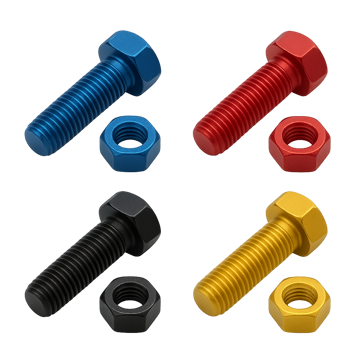
These properties translate into several advantages. Anodized fasteners exhibit excellent longevity in outdoor and marine environments, where untreated metals would corrode rapidly. They can be used for color-coding in manufacturing or for purely decorative purposes in industries such as automotive or construction. The finish produces a non-reflective matte appearance that reduces glare, and the surface is resistant to scratching and minor abrasion. Furthermore, the anodizing process is environmentally friendly, as it does not use heavy metals and produces very little waste compared to other finishing techniques.
Because of these qualities, anodized fasteners are widely applied across many industries. In the aerospace and aviation sectors, they are used for lightweight yet durable fastening solutions in structures, panels, and interiors. In electronics, anodized fasteners are chosen where insulation and corrosion resistance are required. In automotive and racing industries, they are popular both for reducing weight and for their cosmetic appeal, with brightly colored anodized bolts frequently found in engine bays, chassis, and performance components. The marine industry relies on anodized fasteners for their resistance to saltwater corrosion, while architecture and construction use them both for aesthetic facades and structural durability.
Anodized fasteners are produced in accordance with international and military standards to ensure consistency and performance. Standards such as MIL-A-8625 (U.S. military anodizing specification) and ISO 7599 govern the process and classification of anodized finishes. There are also distinct types of anodizing: Type I (Chromic Acid Anodizing) creates a thin oxide layer and is often used in aerospace for minimal dimensional change; Type II (Sulfuric Acid Anodizing) is the most common, general-purpose method and allows coloring; and Type III (Hardcoat Anodizing) produces a thicker, denser layer, resulting in extremely durable, wear-resistant surfaces ideal for demanding applications.
In summary, anodized fasteners combine lightweight strength with enhanced corrosion resistance, wear protection, and decorative versatility. They are integral to industries that require both functional performance and aesthetic options, making them a preferred choice in applications ranging from aerospace engineering to high-performance automotive design.