

What Is a Castle Nut & Why Is It Used?
Castle nuts are used in assemblies where movement, vibration, or changing loads could cause a fastener to loosen over time. Instead of relying solely on torque to maintain clamping force, a castle nut uses a physical locking method to prevent rotation after installation.
You will commonly see castle nuts in applications where reliability matters and failure is not an option, such as in steering systems, suspension components, and aircraft assemblies.
What Makes a Castle Nut Different?
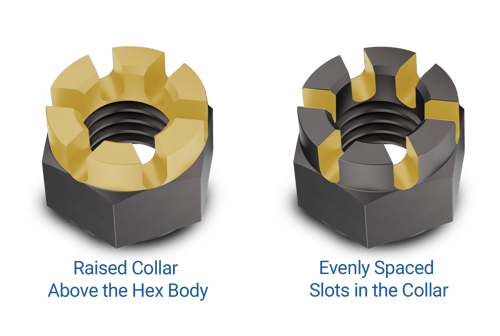
A castle nut, also called a castellated nut, looks similar to a standard hex nut but includes a short cylindrical collar above the hex body, with evenly spaced slots cut into it, as illustrated below. These slots are designed to accept a cotter pin after the nut is tightened.
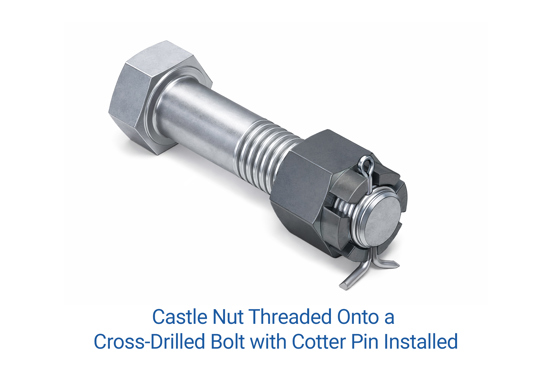
Castle nuts are also designed to be used with bolts that have been cross-drilled. Once the nut is threaded onto the bolt, a cotter pin is inserted through one of the slots in the collar and through the hole in the bolt. The cotter pin is then bent around the nut to secure it in place. Once installed, the cotter pin physically blocks the nut from rotating, allowing it to maintain proper clamping force while remaining locked in position.
Castle Nut vs. Slotted Hex Nut: What’s the Difference?
Castle nuts are often confused with slotted hex nuts, and while they look similar, they are not the same.
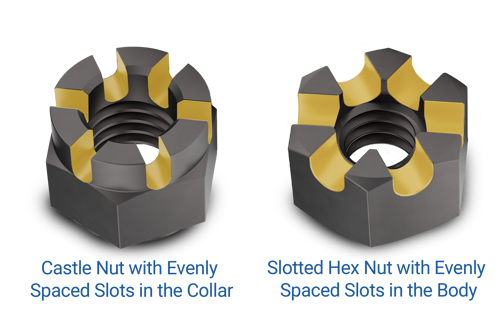
A castle nut has slots cut into a raised collar above the hex. This extra height gives more flexibility when aligning the slots with a drilled hole and helps maintain full thread engagement.
However, a slotted hex nut has slots cut directly into the body of the hex nut itself, with no raised collar. Because there is less material above the threads, alignment options can be more limited, and thread engagement can be reduced depending on the application. Both styles are shown below for comparison.
Each style uses cotter pins to prevent rotation, but castle nuts are generally preferred in higher-load or safety-critical assemblies where strength and long-term reliability are important. For this reason, they are not always interchangeable, even if the thread size matches.
When Is a Castle Nut the Better Choice?
Castle nuts and slotted hex nuts both rely on cotter pins to prevent rotation, but the differences in their design can affect strength, alignment, and long-term performance.
A castle nut is often the better choice in assemblies exposed to excessive vibration, movement, or changing loads. The raised collar makes it easier to align the nut with a cross-drilled hole without backing it off after tightening. This helps maintain full thread engagement and consistent clamping force in critical joints.
Slotted hex nuts may be suitable for lower-load applications or situations where overall height is limited. Because the slots are cut directly into the hex body, there are fewer positions where a slot can line up with a cross-drilled hole, which can limit how the nut is tightened and secured.
Choosing between a castle nut and a slotted hex nut depends on the demands of the application, including load, vibration, and installation requirements. Earnest Machine supplies both castle nuts and slotted hex nuts in a wide range of sizes, grades, and finishes, supported by exceptional customer service and consistent delivery. For pricing or availability, contact our team today at 800-327-6378 or email [email protected].