

Coarse vs. Fine Threads: What’s the Difference?
When working with threaded fasteners, understanding the difference between coarse and fine threads is important, especially when comparing parts or reviewing customer specifications.
At a basic level, it comes down to threads per inch (TPI).
Coarse threads have fewer threads per inch, which means the threads are larger and spaced farther apart. Fine threads have more threads per inch, so the threads are smaller and more closely spaced. Put them side by side and the difference is easy to see, as shown below.
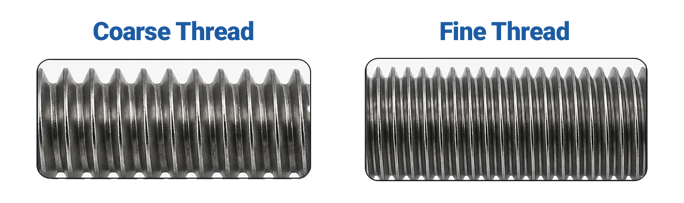
Coarse threads have a deeper, more pronounced profile, while fine threads create more points of contact along the same length of the fastener. This means more thread surfaces are engaged as the fastener is tightened, which can provide better load distribution and improved holding strength in certain applications.
Because of their larger profile, coarse threads tend to be more forgiving in real-world conditions. The wider spacing leaves more room for coatings, dirt, light corrosion, or metal chips without interfering with assembly. If there’s slight damage to the threads, the wider spacing gives the fastener a better chance of still fitting together properly.
Coarse threads are also typically faster to install and assemble because the wider spacing allows the fastener to advance more quickly with each turn. This makes them a practical choice for applications where speed and ease of assembly are important.
Fine threads, on the other hand, are tighter and more closely spaced. Because of the tighter spacing, there’s less room for variation. The tradeoff is that coatings, debris, or minor damage are more likely to affect thread engagement.
However, the tighter spacing that fine threads offer can provide several advantages depending on the application. Fine threads are often used where more precise adjustment is needed, where stronger clamping force is beneficial, or where resistance to loosening from vibration is important. The additional engaged threads can also help distribute loads more evenly across the fastener.
In simple terms:
• Coarse threads = fewer, larger, more widely spaced threads with faster assembly
• Fine threads = smaller, more closely spaced threads with better adjustment control and resistance to loosening
Understanding these differences makes it easier to compare parts and avoid mismatches when sourcing or ordering fasteners.
If you have questions about thread types or customer specifications, Earnest Machine can help. Contact our sales team at 800-327-6378 or email [email protected] to make sure you’re sourcing exactly what you need.