

A Better Way to Write Fastener Part Descriptions
In the fastener industry, there is no universally accepted standard for writing part descriptions.
That might sound surprising, but that's the reality. Two companies can describe the exact same product in completely different ways. Information may be presented in a different order, placed outside of the description altogether, or abbreviated in ways that are not universally understood.
At Earnest Machine, we believe there is a better way.
A part description should clearly communicate exactly what product is being bought, sold, quoted, or sourced. Whether it's a customer, salesperson, buyer, or warehouse team member, the information in the description should be easy to read, easy to understand, and easy to interpret.
Most importantly, it should eliminate any guesswork.
While no official industry standard exists, Earnest Machine has established a standardized approach to writing fastener part descriptions. As part of our ongoing commitment to product data quality and information management, we believe our approach is the clearest, most scalable, and most useful way to communicate fastener information.
The foundation of our approach is consistency. We organize information in a logical order and minimize the use of abbreviations whenever possible. We start with dimensional data and then include additional product characteristics, such as the material specification, grade or class, product name, thread length, and finish when available. Every element serves a purpose, and every description follows the same logical order, helping ensure product information is clear and easy to understand.
To see what that looks like in practice, let's take a look at the example below:

Let's break down each component of the description.
The first section, 1/4-20x1 1/8, is the dimensional data. It identifies the diameter, thread pitch, and length of the fastener. In this example, 1/4 is the nominal diameter, 20 is the number of threads per inch, and 1 1/8 is the length. This information comes first because size is usually the first thing someone needs to identify.
Next is SAE J429, which identifies the material property specification. This information helps establish the mechanical properties associated with the fastener and provides additional insight into the performance expectations of the part.
Grade 8 identifies the strength level of the fastener. This is important because two fasteners of the same size and style may have very different strength characteristics. Without specifying the grade, it can be difficult to understand the performance capabilities of the fastener.
Hex Head Cap Screw identifies the product itself. At Earnest Machine, we spell out product names instead of using abbreviations. Abbreviations may save space, but they can also create uncertainty. A clear description should be written so that anyone can understand it without needing to decode it.
Full Thread identifies how much of the fastener is threaded. This matters because some fasteners are fully threaded while others are partially threaded.
Finally, Plain Finish identifies the plating or coating applied to the product. Finish can affect appearance, corrosion resistance, and the environments in which the fastener is intended to be used.
The value of this approach isn't found in any single attribute. It's found in the structure itself. By presenting information in a consistent order, minimizing abbreviations, and including critical product details directly within the description, Earnest Machine has established a format that provides a complete view of the product within a single description.
As shown below, the same product may be represented differently across the fastener industry. While there are many ways to write a part description, we believe our standardized format provides the clearest and most consistent way to communicate important product information.
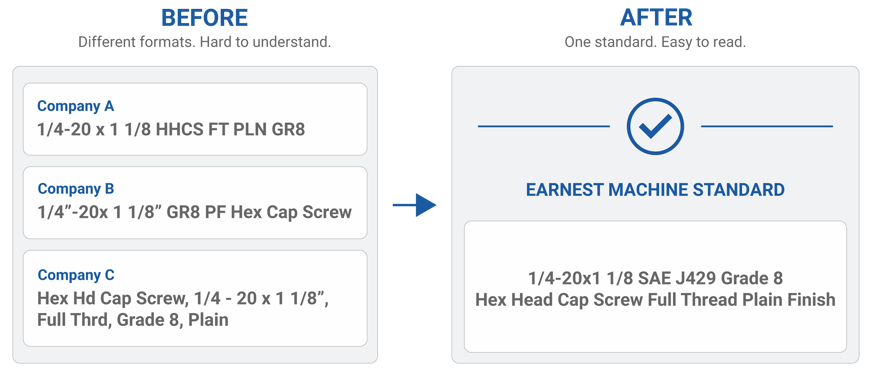
The same philosophy applies to metric fasteners. While the standards and dimensional conventions change, the structure remains consistent.

Although these examples focus on externally threaded fasteners, the same approach extends across Earnest Machine's entire product offering. The specific attributes may change from product to product, but the goal remains the same. A description should communicate the most important information in an order that is clear, consistent, and scalable across a large product catalog.
This is especially important in an industry where products are bought, sold, quoted, sourced, inspected, stocked, and shipped by different people throughout the supply chain. Everyone involved should be able to look at a part description and understand exactly what product is being referenced.
There may not be an official industry standard for fastener part descriptions, but we believe there is a best practice. Include the critical information, present it in a consistent order, spell it out clearly, and eliminate the guesswork. That's the standard we've established at Earnest Machine, and we believe it's the best path forward for the industry.