

Grade A and Grade 2 Fasteners: Similar, But Not the Same
In the fastener industry, Grade A and Grade 2 fasteners are often thought to be equivalent in terms of strength. While these low-strength carbon steel fasteners share many characteristics and are commonly used in similar general-purpose applications, they are defined by different ASTM and SAE standards.
Because Grade A and Grade 2 classifications appear in multiple standards, their mechanical property requirements, including tensile strength, proof load, hardness, and yield strength, can vary depending on the fastener type. Examples include:
- ASTM A307 Grade A specifies carbon steel bolts, studs, and threaded rod
- SAE J429 Grade 2 specifies externally threaded fasteners, including bolts and cap screws
- ASTM A563 Grade A specifies carbon steel nuts
- SAE J995 Grade 2 specifies carbon steel nuts
Although these standards use similar grade designations, they do not define the same products. As a result, Grade A and Grade 2 should not be viewed as universal fastener grades or assumed to be directly interchangeable within an assembly.
Among these specifications, ASTM A307 Grade A and SAE J429 Grade 2 are two of the most commonly compared bolt grades. While both are used in general-purpose fastening applications, their mechanical properties are not the same. One example is their minimum tensile strength, shown in the table below.
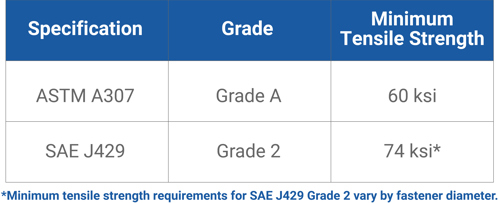
The comparison highlights an important point. Grade designations only have meaning within the standards that define them. Even when two grades are commonly associated with one another, they may not have the same mechanical properties.
The specified standard and grade can also affect documentation, certifications, and traceability requirements. When a customer requests ASTM A307 Grade A, supplying an SAE J429 Grade 2 fastener instead means supplying a different standard and grade than what was originally requested.
In many general-purpose applications, the differences between these grades may not have a significant impact on performance, and some suppliers or customers may be comfortable using either grade. However, that shouldn't be assumed. Before supplying a different standard or grade, it's important to verify that your customer understands the difference and approves the substitution.
The key takeaway is simple. Grade A and Grade 2 are not universal fastener grades. Their meaning depends on the ASTM or SAE standard in which they appear. Understanding that distinction can help prevent sourcing mistakes and reduce confusion when specifying, purchasing, or supplying fasteners.
At Earnest Machine, we stock a wide range of industrial fasteners in a variety of grades, materials, finishes, and industry specifications. Whether you need help locating a specific fastener or sourcing a hard-to-find item, our team is ready to help. Contact Earnest Machine at 800-327-6378 or [email protected]